No, the title is not misspelled: it is simply Portuguese. Traveling to the Algarve is simply a blessing for those of us who enjoy the Portuguese lands.

My country is steeped in this culture. We have the best bread and the best café con leche. Venezuelan fruit shops and liquor stores have a distinctly Portuguese accent.
The spacious houses with enormous corridors and large São José tiles, on the Múcura and Casa Blanca plots where I ran around so many times as a child while accompanying my mother to work, belong to Portuguese families.
My first job, at the age of 14, was picking lemons under a relentless sun on Mr. Teixeira’s farm. He was a well-fed Portuguese man, grateful for the fertile Venezuelan soil.
I grew up surrounded by Portuguese people. Yet, although I never dreamed of traveling to this country, let alone settling here to enjoy its relentless sun, here I am.
And the first thing I remember when I close my eyes and let myself be lulled by the warm sea breeze is a little café con leche from a Portuguese bakery.
Traveling to the Algarve Between Memories and New Landscapes
The smell of peixe coming from the houses facing the fishing port of Fuzeta, in the Algarve, is so intense that it can make you dizzy.
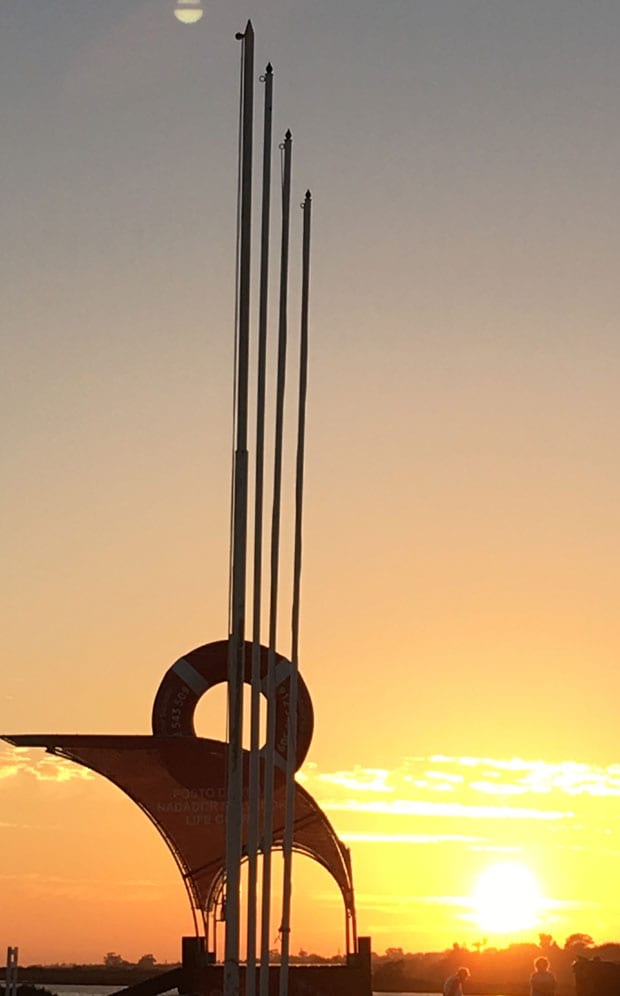
There is noise and a mixture of languages. The English, Germans, and French never miss an opportunity to come south, far south, to Portugal.
I am in the eastern Algarve, close to Spain, and my accent makes itself known.
Many people think I simply crossed the border to buy fine lingerie in Vila Real de Santo António or that I “simply” came to spend a few different days with my Spanish family.
When I tell them I am from Venezuela and actually live in Germany, they immediately rub their arms to express “how cold, Germany.”
Then comes a proud “How wonderful that you are here. Here, there is never a shortage of sunshine.”
And it is true.
A New Life in the Algarve
This is the seventh time we have come, and this time we are staying for a longer period.
We are not leaving Germany. Despite its cold weather, it is the country that has given us tremendous opportunities. We are simply avoiding the need to take vitamin D during the winter.
Just kidding.
We are giving ourselves the gift of watching our children run through the sea and countryside. We chose this land because it brings back so many memories, as if I had lived here before.
The Flavors and Landscapes of the Algarve
We arrived during pomegranate and mango season, with avocados and pumpkins everywhere. These are the enormous yellow pumpkins we call auyamas.
Pomegranate trees are mostly used as natural dividers between plots. The weight of the fruit bends the branches like tired women. They offer their harvest like a feast laid out on a table.
They are enormous pomegranates, deep red, that burst when it rains and stain the little country roads with dramatic splashes of red.

Mangoes grow under cover because rainwater makes them sick and destroys them. Avocados are beginning to grow now and will soon turn everything green as winter arrives.
Traveling to the Algarve also means discovering its beaches after summer ends. Visiting the beaches is now only for the bravest. Despite the water having the best temperatures, for many it is already a luxury they cannot afford.
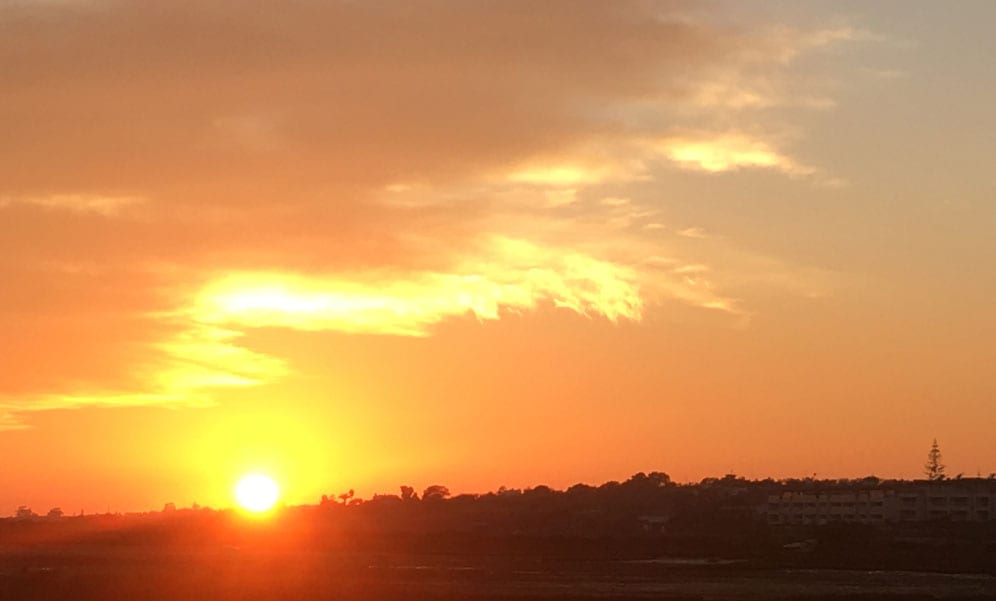
While ordinary tourists return to their countries and to northern Portugal, we dust off our little beach shovels and buckets and photograph sunsets worthy of a movie finale.
Among the area’s typical dishes is “Polvo,” or octopus. Santa Luzia is the “Capital do Polvo,” and octopus is served there in countless ways. Octopus salad is the most common.
I confess that my favorite dish is cod. However it is prepared, it always tastes heavenly.
Desserts deserve a book of their own. There is no pastry shop, café, restaurant, or kiosk that does not sell the popular pastéis de nata, which originated in Lisbon and spread throughout the country.
Afternoons always come with a galão and a folhado de queijo de cabra com mel e nozes. You understand, right?
You understand it, you crave it, and you need it.
Experiencing the Algarve as a Family
We arrived just two weeks ago. Although we missed the first flight that was supposed to bring us here on October 5, we did not lose our excitement or enthusiasm.
The next available flight was on Friday, October 9. We arrived in a rush, wanting to take everything in. We dropped our suitcases, opened boxes, and cleaned the bathrooms ourselves.
The children played and ran around.
Traveling to the Algarve as a family has also meant adapting to a new routine. We are working hard to adjust quickly to so many changes.
Our stay is not forever. Nothing in life is, although that is what people say. Still, we want to make the most of our time in this Portuguese land.
In such a short time, we have already celebrated two birthdays in our little tribe. Now Christmas is approaching.
We hope to adopt some local traditions and cook a typical dish or two.
Our neighbor, who always comes through the patio carrying a basket of fruit—cherimoyas, pomegranates, figs, and mangoes—will teach us about the customs of this land.
I am very excited about living among the accents of this region.
Between Portugal, Venezuela and Memory
I remember that when I was little, I never understood the Portuguese people from Múcura when they spoke. They seemed like very strange men who worked, only worked, and ate.
I cannot help thinking about the phrase “life takes so many turns.” I end up seeing the mothers of my friends, whose families came from the islands, in the Spanish women crossing the border.
In these hardworking Portuguese people, I see the fathers of my friends and acquaintances. I imagine the Portuguese man from the little grocery store around the corner from my house, closing his eyes behind the bars that protected him and sighing as he thought of his beloved homeland, which he probably had not visited since 1960.
My heart aches when I think about it. I imagine him on one of these streets so many years ago, inside one of these houses, packing a suitcase, perhaps, and boarding a ship to Africa, where many went, or to Venezuela, where others found a new life.
During my stay here, I hope to visit Madeira. It is the island I know more than one person longs for.