There is a growing tendency around the world to personify animals, giving them human conditions and characteristics. This trend is especially visible among pets, who seem to have become the new and true masters of the house. However, this reality exists alongside the abandonment and mistreatment suffered by many animals. Rescuing abandoned dogs is one of the responses to this problem.
Family Members

They go to school and university. They have a spa appointment now and then. They have their own neighborhood “gang” —friends they go to school with or meet at the same time, in the same place, or, more precisely, in the same park.
They celebrate their birthdays with cakes and parties specially arranged for them. They even go to psychiatrists or bioenergy practitioners to deal with the stress of the dog’s life they have been given.
Who wouldn’t want to be a dog? With an entire family watching over their well-being and making sure they live a good life, we could all wish to be reincarnated as one of them and enjoy the pleasures of this world without having to worry about the unpleasant aspects of the earth we live on.
Things like paying the bills and getting up at dawn every day to go to work, rain or shine. Being fully aware —some more than others— of pain, fear, anger, sadness, and every one of our emotions. Exposing ourselves to heartbreak, among so many other things.
The Problem of Animal Abandonment and Abuse
However, not all our canine friends are lucky enough to live such enviable lives. Many suffer terribly.
They spend much of their lives, or even their entire lives, struggling against harsh weather conditions, sleeping under bridges, hopelessly searching for owners who now seem almost imaginary, and rummaging through trash cans for something to eat.
They have to fight to survive the abuse, violence, and aggression that we humans unjustifiably inflict upon them.
Animal abandonment and animal abuse also raise a debate about the priorities of solidarity and the protection of living beings. In this context, rescuing abandoned dogs becomes an essential task.
For some people, it is difficult to understand why anyone would choose, through wills, foundations or donations, to help four-legged animals rather than children who are starving in different parts of the world, or women and elderly people facing difficult circumstances.
One particularly memorable case involved an irreverent Colombian writer who, several years ago, won a substantial prize and decided to donate the money to the stray dogs of Caracas, the city that had given him the award.

The media and critics immediately turned against him, not only because he had donated the money to animals instead of people, but also because he had not donated it in his own country. This was hardly surprising, considering that the acclaimed but eccentric writer despised his homeland.
The main argument made by animal rights advocates and their supporters is that they help animals before people because humans are the ones who harm them, while animals often lack the tools to defend themselves.
This is just one of the many occasions on which the debate over whether it is unjustified to help animals before people has resurfaced. Indeed, our solidarity should first be directed toward humanity.
It is also true that helping animals is valid and important precisely because they often have no one to help them. They are victims of human cruelty and sadism. They are living beings that feel, suffer, and deserve to be protected.
Rescuing abandoned dogs seeks precisely to offer a second chance to those who have been exposed to abandonment, hunger and abuse.
In this way, animal abandonment and abuse become issues that demand attention, responsibility and concrete action.
Creating the Foundation
In my opinion, anyone who does something to improve this world, who dedicates some of their time and resources to a noble cause and to helping others, is immensely valuable and deserves recognition in a world that seems to be becoming increasingly selfish.

It does not matter whether they want to help stray dogs, the environment, orphaned children, captive dolphins or women who are victims of violence. What matters is the desire to help and the actions taken to look beyond ourselves.
Daniela Castilla is one of these people. She is a remarkable and courageous woman. She is young, yet it can be said that she has spent her entire life fighting for dogs without a home. She fights for dogs living in poor conditions and encourages people to adopt dogs from foster homes or shelters rather than buying expensive dogs for their children. She also works to improve the quality of life of other animals at her foundation.
Her work represents a concrete form of rescuing abandoned dogs, but also of helping them recover and find new families.
She lives to help animals, which is why she studied ecology. It was the professional path that came closest to what she considers, beyond a life project, her true mission.
Today, she divides her time between the corporate world, where she also creates an impact by working for a company that provides corporate solutions for all kinds of businesses, and her personal life and Fundación de Protección Animal Dejando Huella, which, according to its profile, is “a nonprofit organization created to help abandoned and/or abused animals.”
We would like to be able to rescue every abandoned dog, but unfortunately, because of financial and space limitations, we can only rescue a few. That means we have to decide which dogs need our help more than others, or which ones need it most urgently.
After speaking with Daniela and hearing the heartbreaking stories of animal abuse and torture she has encountered and helped address, we better understood the importance of rescuing abandoned dogs.
You begin to understand the importance of helping and taking decisive action to combat animal abuse. We had the great opportunity to interview her, and she taught us a great deal. Thank you, Daniela.
Providing Help
Solkes: What exactly do you do for abandoned and stray dogs? What does your work involve?
Daniela Castilla: At the foundation, we take care of dogs that nobody wants anymore. The elderly, the sick, those who were bought as puppies and grew too large, the blind. These are the dogs we rescue. We currently have 67, all of them rescued from the streets. Most are female. People get rid of female dogs because they believe they are harder to control when they go into heat, and they do not want to pay for sterilization.
However, I must say that there are dogs we simply cannot leave behind. Most of them are very sick and terrified of humans. The main ingredient in their recovery is love and teaching them to trust again the very beings who have caused them so much harm. That takes time and dedication. The first thing we do is give them a name.
This process shows that rescuing abandoned dogs does not end when an animal reaches a shelter. It also involves restoring their health, trust, and ability to connect with others.
The dog needs to feel recognized. It is no longer “just another dog.” Now it has a name and someone who will take care of it. We take it to the veterinarian, and that is where the physical healing begins. However, emotional wounds are the hardest to heal. Over time, we can say that the dog is fully rehabilitated and ready to find a home where it will be loved and respected for the rest of its life.

Solkes: How did your interest in helping animals begin? How has it grown and changed over time?
Daniela Castilla: I have always lived surrounded by animals. Not just dogs, but also cows, horses, cats, and goats. I grew up on a farm outside Bogotá, where my mother always taught me to love animals and explained the importance of caring for the environment. As a child, I had the opportunity to live on a farm where we produced what we needed. Everything was available to us, but we had to work for it and grow it ourselves. That is how I learned to value the land, the countryside, and animals.
The farm where I grew up is now the foundation’s shelter, where the dogs live. Everything in life comes full circle. They now live in the place where they once took care of us.
The dogs were our protectors. They accompanied us while we worked on the farm and looked after us. On some occasions, they even protected us from burglars because they would alert us with their barking and changes in behavior.
From childhood, I learned the value and wisdom of nature because I lived surrounded by it. I understood the concept of sustainability from an early age and the importance of every animal. Every living being has a role to play in this perfect order, and dogs have the important role of being guardians and protecting humans so that we can carry out our work.
Speaking for Those Who Have No Voice
Animals, especially dogs, are a driving force in my life. They are a source of support and unconditional companionship. My passion for helping them has grown tremendously over time. Castilla is aware that we live in a society that fails to respect and often ignores animal rights, mainly because animal abuse frequently goes unpunished. Someone has to speak for those who have no voice.
The greatest achievement and growth we have experienced during this time, and the most important moment, has been the creation of my foundation. We support ourselves with our own resources. Sometimes we lack material things for the dogs because this is an expensive undertaking, but the most important thing of all will never be missing: love.
The rescue of abandoned dogs thus became a fundamental part of our mission.

Solkes: Is your Foundation and your work focused exclusively on dogs, or do you also help other animals? What does this help involve?
Daniela Castilla: At the Foundation, in addition to the dogs, we have one cat, five donkeys, and two horses. All of them have been victims of animal abuse. The horses and donkeys are not ridden… At the foundation, we say they are already retired. They spent many years of their lives working under deplorable conditions and carrying much more weight than they could handle. That is why we make sure they can rest and enjoy the years they have left.
We promote animal adoption. We want to change people’s mindset and help them understand that a dog that was once homeless or abused has such a pure heart that it can learn to love and trust a new family again.
When someone contacts us saying they have a dog they can no longer keep, or that they have rescued a dog but the foundation cannot take it in, we publish the case on our social media in order to find the dog a permanent or temporary home.
All adoptions are handled through the Foundation. Interested people must fill out a form. Afterwards, we conduct a home visit together with the dog to determine whether the family is suitable for adoption and whether it is the right family for that particular dog.
Solkes: Tell us about one of the most extreme cases you have dealt with, one that affected you the most.
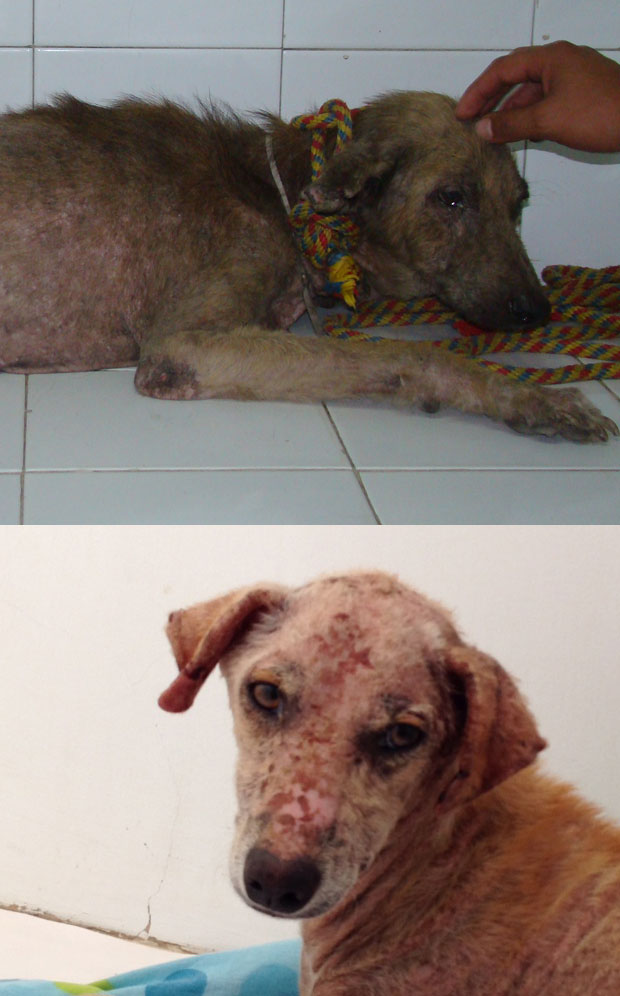
Daniela Castilla: I have witnessed so many cases of abuse and abandonment that it is difficult to name just one. But I will tell you about Dante. We rescued Dante on a beach outside Cartagena on January 14, 2013. He had severe mange, sunburned skin, and as a result, fungal infections had developed on his skin. He tested positive for Ehrlichia, a tick-borne disease, and was also anemic. After visiting three veterinarians, the conclusion was that it would be better to put the dog to sleep. But something told me that we should try for a few more days —or months.
Dante would not eat or drink water. He rejected all the oral medications we gave him, and they were beginning to cause side effects. There was nothing else we could do. We had no way to treat Dante, and we thought it was time for him to rest after the cruel life he had endured.
That was how we ended up taking Dante to Bogotá. We had to make the journey by car because we had no way of bringing him by plane. We did not have, and would not have been able to obtain, a health certificate. When we arrived, we visited another veterinarian. They wanted to insert an IV to give him fluids and intravenous antibiotics, but it was impossible to find his veins because of his advanced anemia.
The next day, he got up and started eating on his own, as if he had understood the conversation my mother and I had had the night before as we tried to decide his fate. That was when his recovery began. Dante did not take any medication after that and recovered from several diseases that are usually fatal.
Dante’s recovery process took four months. The hardest part was earning his trust.
Because of the burns on his skin and the fungal infections, Dante had a very unpleasant odor. For this reason, people would always chase him away from wherever he tried to settle. He also had a couple of burns caused by hot water, which people had probably thrown at him to make him leave.
Today, Dante is an incredibly loving dog. At first, he was somewhat distrustful of people he did not know. He has now fully recovered, except for a tic that remained as a result of distemper. Some time later, we had the opportunity to visit the place where we had rescued Dante again. We were told that he had been abandoned when his skin problems began.
Dante’s case shows what the rescue of abandoned dogs can truly mean: not only saving an animal from the streets, but accompanying it through a long process until it regains its health and trust.
How an Animal Foundation Is Funded
Solkes: Where do you get the resources to finance and maintain your foundation and keep this beautiful work going?
Daniela Castilla: I am fortunate to have my mother’s support. She is a retired woman who gives everything she has to animals. With her pension and my income, we manage to support the dogs. We do not always have everything we need, but there is always food and an infinite amount of love. Occasionally, we receive help from people who want to make a difference. People have donated dog food, bowls, medications, and cleaning supplies. These donations are not regular, so there are entire months when we receive nothing.

Solkes: Who helps you with this work? Do you have employees? How do you balance your charitable work with your job, your daily life, and your personal life?
We must teach them to value and respect life. I cannot expect other people to love animals as much as I do, but I can ask them to respect them.
Daniela Castilla: A family with two children lives at the shelter. They are responsible for caring for and feeding the dogs every day. My mother goes to the shelter every two or three days, and I only go on Saturdays and Sundays because my job requires me to be in Bogotá from Monday to Friday. Taking care of 67 dogs is an enormous responsibility. In my personal life, I have had to give up many things and adapt to many others, but I have never regretted it. Giving to them without receiving anything tangible in return —because they are experts at giving back what we do with love, affection, and loyalty— is an expression of love and respect for them.
There is nothing more rewarding in my life than seeing a dog recovered and happy. In fact, I feel the opposite. I believe that the idea of helping stray dogs, dogs nobody wants, and dogs in need makes me a better person.
What’s Next
Solkes: What comes next? Where do you want to take your work? How can people support the beautiful work you do?
Daniela Castilla: There are many dogs we cannot put up for adoption because of their age, their behavior, or simply because they have been with us for so many years that placing them in a new home would be too drastic a change for them. That is why we are working hard on our sponsorship program. This involves covering the care and maintenance expenses of one of our dogs. It is a relatively low monthly contribution.
When you sponsor a dog, the foundation commits to sending weekly photos and providing updates about any activity, such as bathing, veterinary visits, purchasing food, toys, and so on. We are also organizing bathing days and donation drives so that people can get to know the shelter and become involved. That is part of our work.
These actions also help strengthen the rescue of abandoned dogs and provide them with better conditions while they wait for a family.
Solkes: What do you believe is the main cause of animal abuse? What can be done to reduce and prevent it?
Daniela Castilla: The main cause of animal abuse is ignorance. Many people buy dogs without understanding the implications. It is essential to learn which breed is suitable for each family. You have to consider the space available, expenses, time, and the commitment required to care for a dog. To reduce and prevent abuse and abandonment, we must educate our children. That education begins at home.
We must understand the importance of adoption. Many dogs need a family. When you decide to adopt an animal that has been rescued and is living in a shelter, you are saving its life. You are giving it the opportunity to be loved and have a permanent home. In addition, when the pet you take home leaves the shelter, you make room for another animal to enter and begin its own recovery and rehabilitation.
Adopting a pet that has been a victim of abuse or abandonment is an act of love. It is also the perfect opportunity to teach your children values such as responsibility, care, and compassion. You are also teaching them the true meaning of unconditional love.
Solkes: Some people criticize animal welfare foundations because they believe that, given the number of children, elderly people, and others living in extreme need, aid should go to them before animals. What do you think about this? Why help animals before people?
Daniela Castilla: I believe that helping animals is just as valid as helping people. If you compare the number of foundations supporting children, elderly people, and people without resources with the number of foundations that help animals, you will find that there are far more of the former. I chose to help animals because they are infinitely grateful beings, and they have no way to speak, defend themselves, or ask for help. They depend entirely on us.
I consider myself very fortunate to have been born and raised with the gift and the opportunity to help dogs who are rejected and mistreated by so many people.
A Life Dedicated to Animal Protection
Solkes: How would you describe the dogs that have been part of your life over the years? Are they pets, or are they something more? What do you believe these animals mean to you, and what is the difference between having pets and having animals as an active part of our lives?

Daniela Castilla: The dogs that have accompanied me throughout my life are my family. They are part of me. I live and work for them. I have lost many along the way, but I keep going because I know there are others who need me. To me, my dogs are much more than pets. They are living beings. They feel, and they deserve love and great respect.
And after meeting with Daniela, I can say that I not only understand but also appreciate all those foundations that, like hers, are dedicated to rescuing abandoned dogs and helping animals in need. All I can say is that, without a doubt, we are the barbarians.