Sometimes we forget that the main purpose of the internet and this era of connectivity within everyone’s reach is precisely to keep us connected. Regardless of the time, place, religion, or circumstances of the corner of the world where we live. Wiki Mujeres Colombia is an example of how the internet can become a tool for building community, sharing information, and helping one another.
As tempting as it may seem, the internet was not originally designed to publish photos of the delicious lunch we are eating. Nor was it created simply to make our latest —and not necessarily long-lasting— relationship status public.
An Essential Tool: Wiki Mujeres Colombia
This essential tool in the lives of millions of people today was conceived from the beginning for practical purposes and with the goal of narrowing the gaps in a world as vast and diverse as ours. At times, information seemed to be available only to a privileged few rather than to all citizens of the world, as it ideally —and perhaps somewhat utopically— should be.
Likewise, the renowned social networks should also be effective communication systems through which societies and communities can strengthen themselves and help one another. They should help us become better societies while reinforcing the cultural beliefs and practices of those who make them up.
The Real Concept of a Social Network
The name used by online communities such as Facebook, Twitter, and Instagram, among others, comes from the real concept of a social network: “A social structure made up of a set of actors, such as individuals or organizations, that are related according to some criterion, such as professional relationships, friendship, kinship, etc.” The type of connection represented in a social network is an interpersonal relationship or tie.
Following these principles, we should be more concerned with creating a truly useful support network among our virtual friends than with making sure they know what we look like in a bikini or whether it is hot today.
Famous and influential people do not necessarily contribute to this idea either. They fill their social networks with an endless number of followers who follow the crowd and dream of places, fashions, and trends that are often beyond their reach.
The original purpose for which I created it is that it doesn’t matter who you are. What matters are values and respect… what matters is the heart.
Organizations have also become part of this tendency to be present on social networks. Companies and large corporations have accounts managed by Community Managers, who occasionally publish relevant information.
They also fall into what seems to be the prevailing trend of filling the walls and publication spaces of each network with all kinds of information, with the sole objective of gaining visibility and ensuring that their posts remain visible to as many people as possible.
Wiki Mujeres Colombia: A Support Community
In Colombia, there is an exception to this rule, in which social networks increasingly seem useless. It has grown so exponentially that it now has subgroups in several countries, cities, and small virtual communities that have gradually become real communities.
This is WikiMujeres in Colombia.
It is a secret group that uses Facebook as its platform. Only women can join —and not simply anyone who wants to.
Certain requirements and parameters must be met to enter. The group has generated so much impact, curiosity, and discussion that even a famous journalist from Bogotá requested permission to join, if only for one day, to understand this phenomenon in depth, experience it, digest it, and later be able to speak about it with sufficient knowledge.
It is a group of more than 8,000 women who follow a set of rules, a code of conduct, and guidelines for its proper functioning. At the same time, they all perform the role of Community Manager.

It is a network where 8,000 people publish mostly relevant information while also making sure that the group remains, above all, a space of respect, harmony, and positive coexistence among all its members.
However, what exactly the group is for and what kind of information is shared there has not yet been fully explained.
The Services of Wiki Mujeres Colombia
The group is literally useful for everything. From finding an address or recommending the best pediatrician in the area for mothers —who make up the majority of the group— to raising large sums of money for social causes that are published and amplified through the group.
It can help prevent theft, find services and all kinds of assistance, locate lost pets and return them to their homes in record time, or organize a dinner with everything needed for a special occasion, including all kinds of gifts. And all of this can be done without leaving home, since most of the products offered through WikiMujeres also come with home delivery.
For this report, and although I have been part of the group almost since its beginnings and can personally testify to how it works, the benefits it provides, and the seemingly infinite reach it has acquired, I wanted to explore how it has become the number-one solution for many everyday problems and concerns.
It is worth clarifying that I have also been a “victim” of criticism, particularly from husbands, who accuse us of being addicted to Wiki and having no life beyond the group. Paradoxically, they are often the same people who, whenever they need something they know can be solved within minutes through the group, stop their complaints for a second and say: “Ask Wiki.”
Evolution can be explained through the metaphor of an onion. Through the group, women have increasingly expressed themselves from their true essence, and we have gradually reached the point where, together, we can talk about what lies at the heart of the onion, removing layer after layer in our daily lives.
Geraldine Pomato, Creator of Wiki Mujeres Colombia
Its creator, driving force, and organizer is a young Argentine woman who lives in Colombia because of her family. She is married to a Colombian man and is the mother of two Colombian children. She is an expert in marketing, consumer psychology, and new trends.
She had already worked successfully as a blogger covering important women’s issues, such as motherhood and the ongoing dichotomy between work and being a woman and a mother. She is also passionate about new digital trends, the potential of virtual communities, and the true purpose the internet should have.
She created an exclusively female group because she believes in the power and strength of women. She believes that women have underestimated for too long the effect that genuine sisterhood and a union based on mutual benefit can have among us.
She created it in Colombia not only for the obvious reason that it is where she currently lives and will probably remain for some time, since her life is established there, but also because she believes deeply in Colombia and its people.
She likes the country and enjoys its people and characteristics. But she also dreamed of helping Colombian women shed some of the stigmas and pressures they carry because of certain social characteristics inherent to the society in which we live. In many cases, women do not have a space where they can express themselves freely, without worrying about appearances.
Wiki: The Group
The group operates as a genuine community, with rules, guidelines, principles, and limits governing interactions among its members. Although it is essentially virtual —and that is how it was born and how it will remain— it has gradually become, above all, a real community.
Women are forming bonds, friendships, and personal relationships. As a result, the support network is no longer merely virtual but also real.

Wiki connects thousands of women because they have something, or many things, in common. They discover that positive, sisterly relationships based on mutual support among women are indeed possible.
All the women who belong to the network help one another because the basic principle is: “Someone has or knows what I need, and someone else needs what I know or have.”
Through this exchange of information, they get to know one another and strengthen the bond of the Three Musketeers: truly, one for all and all for one.
When I asked more than 30 women —the first ones to respond— they all agreed that one of the fundamental reasons for the group’s success, if not the most important, is that Wikimujeres in Colombia is more than a network, group, or community. It functions as a sisterhood.
The Interview
For all Solkes readers, we are publishing the interview with Geraldine Pomato, creator of Wikimujeres in Colombia. Through it, readers can learn more about the group’s origins, internal functioning, characteristics, and anecdotes. This will help them better understand its rise and success, and why everyone in Colombia wants to become a Wiki woman.
Some of the interview questions were suggested by members of the group. Each of those questions includes the name of the person who submitted it.
Juanita Bernal Sanint: I have been part of the group since its beginnings. However, I would like you, as its creator, to tell us firsthand: What is Wikimujeres, how does it work, how did the idea come about, and how has it evolved over this past year? I would also like to know what this project means to you.
The success lies precisely in the fact that we all feel we can talk about every subject. It is a space where loneliness is broken because there is a sense of identification.
Geraldine Pomato: Wikimujeres in Colombia is a space where women will always have an echo, and that does not always happen in everyday life. Women do not have a voice in everything, and this is a space where women can talk about absolutely anything.

There is something that makes it different. Problems belong to everyone. My problems, your problems, they are everyone’s problems, and everyone takes them on. We are all going through the same things. We have the same concerns and the same fears about speaking and expressing ourselves.
It is a space for breaking the paradigm and realizing that we can do much more.
The idea emerged because when I arrived in Colombia, I realized that women here are somewhat more reluctant to break certain paradigms because of existing prejudices. They therefore feel more confined and have greater resistance to speaking openly.
It emerged not only as a space where women can speak and express themselves, but where they must do so “with a clean face.” Everything has to be done using your real name. That is part of changing the mindset, taking responsibility for what I say, without repressing myself from saying it.
It is a space where we realize that we are all real women who suffer from the same conditions, ranging from insignificant concerns to major dilemmas. By expressing them, we begin taking action and, at the same time, taking responsibility for our role as active women.
For me, it represents a challenge. It means demonstrating that it can be done, that women can take responsibility and take action using the immense reach and alternatives offered by our power.
It means proving that everything books tell us about collective work and the benefits of community can actually be achieved through effort and cooperation.
It is an opportunity to demonstrate that gratitude is an “emotional salary” and that societies function when other people’s problems become my problems, and I offer advice, help, or information selflessly, simply because I feel the satisfaction of having helped.

JBS: If you could define the group in three words that characterize it, what would they be?
GP: Community, because I feel that it is a real community and that it truly works. Community or sisterhood, actually, because what has been created is a sisterhood.
Respect.
And the power of women to undertake, create, and accomplish a thousand things at once. The power of what we can achieve with our minds alone. The information we have and a computer are enough to become part of an effective network and a true social community.
And also the power that lies within every woman. Not waiting for others to do something for me, but having the power to change the world. The power to file a complaint respectfully and generate change. The power to make decisions when buying something or choosing a service. The power to create change and make things work properly, always with respect and purpose.
I have also been surprised by women who have left their jobs because Wiki encouraged and helped their businesses take off. Now they have jobs that make them happier and help them fulfill their life purposes. It is a push toward entrepreneurship and gives women power from their own homes.
JBS: This is a group that constantly surprises us positively and shows us that there is strength in unity. Tell us about some of the cases that have surprised or affected you, where women have been able to support one another and solve things that seemed impossible.
GP: In one week, we managed to have a book by a YouTuber for teenagers removed from circulation. The book encouraged teenagers to have sexual relationships, behave rudely, and engage in many other things that were not appropriate for healthy social development.
I said to myself: this is pure Wiki power.
There have also been situations involving complaints about restaurants and public places where establishments responded very quickly and, above all, effectively, resolving the concern or problem that had been raised.
Those kinds of things make us realize that we are united and that there really is collective power.
I would like to make a brief aside. In addition to interviewing its creator, I decided to conduct a small experiment through the group itself. I posted asking who would like to tell me about the group and answer a question for an article I was writing.
I received not only wonderful contributions and comments but more than 80 interactions in less than two hours. In fact, after two hours I had to post an update asking people to please stop responding or the article would become endless.
Carolina Yepes: How do you manage to do all of this without making money from it? Is there a possibility that at some point you could profit from it and that other women could also benefit financially from this work?

GP: I have turned down job offers from places where everyone would dream of working because I believe in the group. I believe that later I will look back and know that the decision I made was the right one.
I dedicate between 16 and 17 hours a day to it. This is my job, my project, my business.
Obviously, one of the projects for this year is not only to be able to make money myself, but to create a space that provides jobs for many women and is sustainable and profitable.
We are developing a portfolio with different things we can offer brands, so that many women can work from home and also benefit financially from the group.
The portfolio is designed to maintain the community exactly as it is while creating the opportunity to generate income for many women. Only brands that share our values and come to benefit the community will be able to establish partnerships with Wikimujeres.
Lina María Ramírez: Do you think the group’s success is because it is exclusively for women? If you were offered the opportunity to manage a Wiki for men and women, would you do it? And if so, what would the first rule of the handbook be?
GP: I don’t know if the success comes from being exclusively for women. It works because it is based on a one-to-one relationship. That is why I like working with women, because it is work from the inside out.
We first have to work on ourselves as women before we can think about becoming a mixed group. First, we have to make it work as it is.
Continuing with the interview…
JBS: I was deeply moved by the case of Jerónimo and the thousands of donations and funds that were raised using the group as a platform in just a few days. Tell us a little about how this happened, how it began, whose idea it was to support this cause as a group, and what lesson you took away from it.
Jerónimo is a little boy who was diagnosed with recurrent leukemia after many years of treatment. He needed an enormous amount of money within just a few days to begin the only treatment that could give him and his family hope. Wikimujeres in Colombia joined the cause and managed to raise a considerable and significant amount of money through a campaign, a marathon, and various activities organized within the group.
GP: Everything happened naturally with that cause because Natalia, his mother, is in the group. From there, the sisterhood was activated.
It is something that could happen to any of us, and we identified with her so strongly that, as always, it became everyone’s problem.
A force and power were activated that were not only economic, through donations, but also political and journalistic. Among other things, we managed to bring the case to the national media and spread awareness of it.
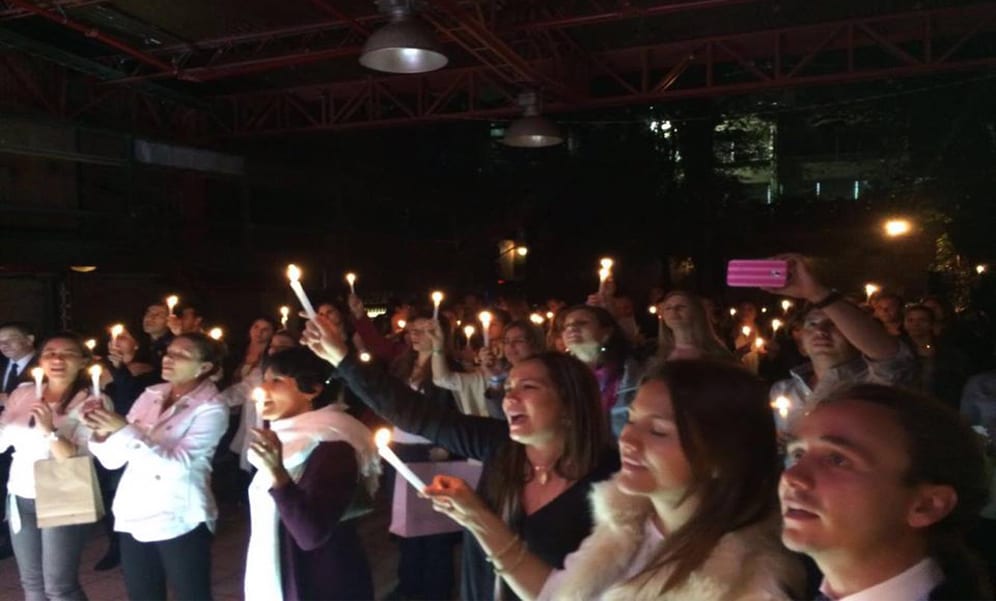
We all became emotionally involved because it could have been us. Together, we began doing something. Some contacted agencies, others the media, others the family. It was a completely collective effort that mobilized everyone toward the same goal.
I believe we achieved this because we worked from the heart.
We had broken through the layers of the onion, and each heart connected with other hearts. An umbilical cord was formed.
If it were mixed, it would simply be another Facebook group. Being female is what defines us.
The first rule would be to think like the opposite sex. By thinking in this way, paradigms are already being broken, and the layers are being removed, allowing us to achieve the objective.
JBS: How many countries have created groups based on the main group? How many subgroups are there? How do they work? To belong to one of them, do you have to be part of the main group?
GP: At the moment, there are 20 countries that have created specific Wiki Mujeres groups. There are some groups, but no more can be created unless they are specific support subgroups, because the idea is for everything to develop from the main group.
To be part of a subgroup, you do have to belong to the main group. To be part of a country-specific group, you do not, because each one creates its own filter and each group grows with its own people.
I am the administrator of all the groups, so I have to mediate in all of them in some way. They are all secret and all exclusively for women.
JBS: Thank you very much, Geraldine, for everything you do every day: for your innovative and creative ideas and entrepreneurship, for your dedication, and for the time you gave us for this interview.
Conclusions: Wiki
This is only a small glimpse of the wonderful woman that Geraldine Pomato is, charming in every sense of the word.
Wiki Mujeres in Colombia will undoubtedly continue to make headlines and grow at an extraordinary pace.
In fact, by the time this article was published, Geraldine and the group had been invited to an international marketing fair that would soon take place in Bogotá, where they would present the experience as a successful global marketing case.
Wiki Mujeres is a reality that will spread to other parts of the world. There is no doubt about that.
What will not happen is the creation of more subgroups.
As all of this unfolds and we continue to grow exponentially and in an exemplary way, I, together with the other 8,025 members as of April 14, 2016, can proudly say: I am proud to be a Wiki woman.