Catalina Mejia builds her music like opening an inherited photo album: each song is a sound image where memory, territory, and emotion coexist. A Colombian-German singer-songwriter, electronic engineer, and cultural manager, her work dialogues between tradition and the present, between science and sensitivity, shaping an artistic project deeply rooted in family history and Colombian music.
The Colors of a Living Legacy
The first sounds of an album sometimes arrive not as notes, but as memories. As if something stored in memory suddenly found a way to breathe again.
In the case of Catalina Mejia, this return is not accidental: it is a conscious search to name the origin, to listen to what remains even as time moves forward.
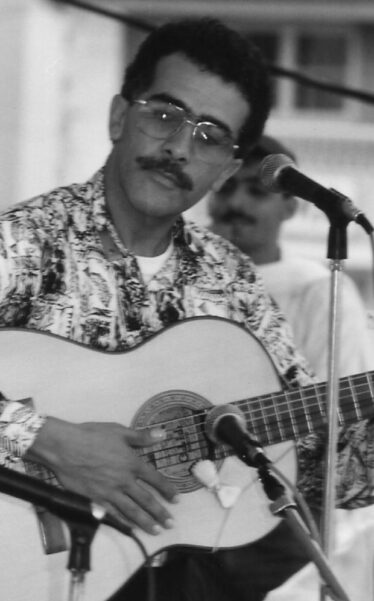
Some albums are listened to and others that are inhabited. The Colors of My Ancestor belongs to the latter category: an emotional territory in which each song serves as a bridge between generations.
This work, her most recent album, is much more than a record: it is an act of homage and continuity.
In her ten songs, Catalina Mejia pays tribute to two fundamental pillars of her life: the musical roots of the Colombian Andean region and her father, Maestro César Augusto Mejía Anicharico, a key figure in this tradition and part of the country’s intangible heritage.
The album thus emerges from a convergence of territories and memories. Andean and Caribbean traditions intertwine as a reflection of her family history: a father from Zaragoza, Antioquia, and a mother from Chiriguaná, Cesar.
From this encounter arise soundscapes that traverse cumbia, bambuco, guabina, and danza, woven with a sensitivity that honors tradition while reinterpreting it from the present.
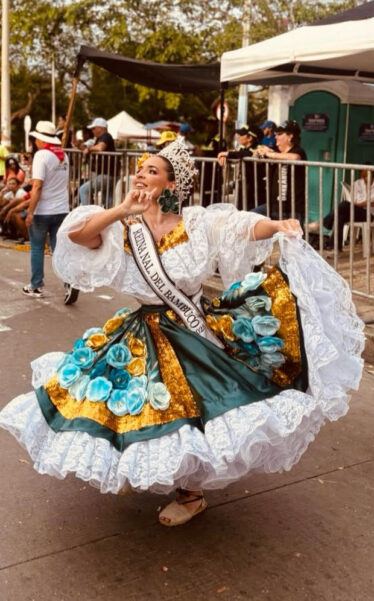
Cumbia manifests with its vital and collective pulse, evoking celebration, drums, and shared roots.
Bambuco, in contrast, opens a more intimate, almost confessional space, where melody becomes memory and inner dialogue.
Guabina appears with an almost whispered delicacy, connected to the everyday, the rural, and the deeply human.
Meanwhile, danza introduces a structured elegance, a heritage that travels from generation to generation without losing its form.
Together, these rhythms construct a language where the ancestral is not preserved as a relic but transformed into living matter. Each song functions as a musical postcard.
Amigo, which opens the album, condenses the bond between father and daughter beyond blood: an intimate reflection on the care of affections throughout life.
Gozadera celebrates the simple fact of being alive, while Intuición explores human resilience through an instrumental format deeply linked to the Colombian trio tradition.
Throughout the album, water, travel, night, memory, and time appear as recurring symbols.
From the delicacy of Agüita to the introspection of Noctámbula, passing through the family story narrated in the title track, Catalina Mejia weaves a tale where the personal becomes collective, and music acts as an emotional archive.

This work not only looks to the past: it activates it. In Los Sonidos de Mi Tren, the closing track, life is understood as a journey between reality and illusion, inviting listeners to inhabit the present without rush.
Thus, The Colors of My Ancestor becomes an intimate map connecting generations, territories, and sensibilities, reaffirming Catalina Mejia’s voice as one of the most singular in contemporary Colombian music.
Catalina Mejía between Territory, Migration, and Stage
Living between two continents does not mean dividing identity but expanding it. In Catalina Mejia’s music, each place leaves a distinct mark, as if each landscape also resides in memory.

The Andean mountains, the Colombian Caribbean, and European cities coexist as inner territories activated through sound.
The Caribbean emerges with its intense, almost liquid light. The air is warm and salty, the skin imbued with moisture, and rhythms seem born from the body before the instrument.
Drums resonate in the distance, voices intertwine with the murmur of the sea, and time stretches across vivid colors, open streets, and spontaneous encounters.
In contrast, European cities unfold with a different texture.
The sound of footsteps on pavement, the contained echo of train stations, the orderly cadence of cafés, and light filtered through gray skies create a more introspective atmosphere. Here, silence also has presence.
Between these two worlds, Catalina Mejia defines herself as a singer-songwriter deeply rooted in Latin American folklore, with a sensitive gaze toward the social, the human, and nature.
Her music, she explains, emerges from the fusion of traditional rhythms and contemporary elements, not only to invite reflection but also to celebrate the diversity that defines us.
She currently resides in Zirndorf, southern Germany, an environment offering calm, structure, and space conducive to creation. However, her musical life moves between Germany and Colombia, in constant motion, where each territory fulfills a distinct role.

Colombia is the root, the place where music is experienced collectively and organically. Germany, on the other hand, is the space from which she projects her work, where distance transforms memory into a more conscious listening.
This migratory experience is not without challenges. Emotional distance from family and close loved ones appears as one of the greatest difficulties.
Learning to rebuild networks and adapt to new languages and ways of life requires a demanding process, but it also opens possibilities for growth and connection with new communities.
In this transition, Catalina Mejia does not speak of dualities but dialogue. Her training as an engineer and her artistic path complement each other. Science provides structure, analytical thought, and discipline; music brings sensitivity, intuition, and expression.
The same logic extends to the stage.
Although her commitment to music remains intact, performing experiences vary by context. Singing in a subway station exit is not the same as performing in an auditorium where the audience comes intending to listen. In each space, energy transforms.
Yet, something remains: the root. Even in movement, music remains home.
The Dialogue Between Father and Daughter: Music as Living Heritage
Sometimes the deepest stories are not told: they are inherited. They filter through gestures, voices, and shared silences. They pass from generation to generation without need for explanation, like a constant presence that accompanies even when unnamed.
Some memories do not fit in photographs. Some stories cannot be written in letters. Yet some lives are transmitted through sound.
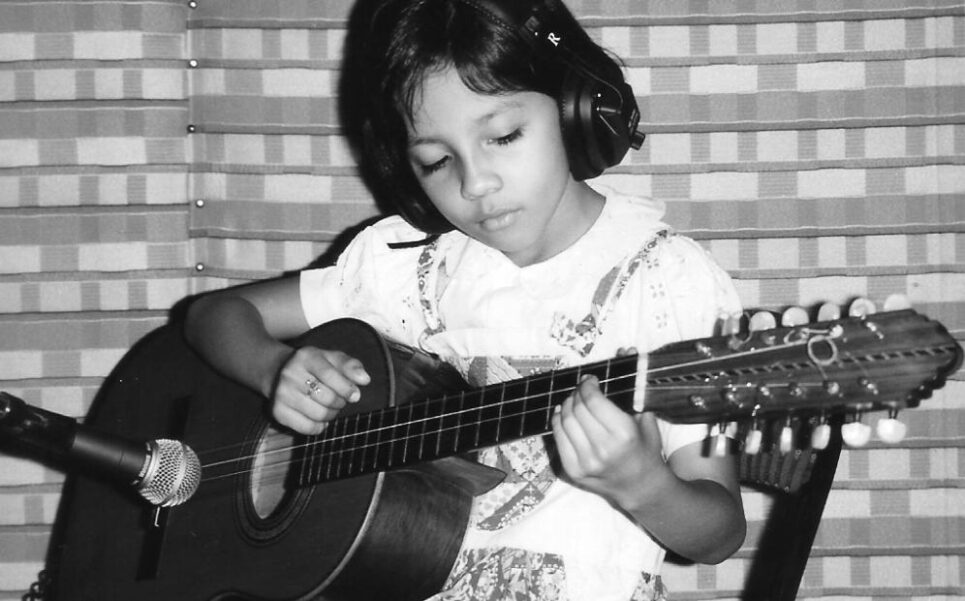
In Catalina Mejia’s trajectory, music is the space where the past breathes.
There appears her father, not as a distant reference but as a living presence. A companion, a mentor, a voice that dialogues.
His influence has been fundamental, not only musically but also humanly. Catalina grew up observing his discipline, commitment, and his way of understanding music as a vehicle to connect with people.
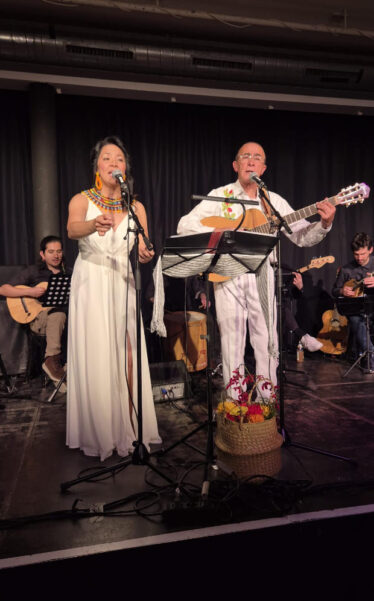
Beyond technical knowledge, he taught her to listen, respect tradition, and find her own voice within it.
The Colors of My Ancestor arises largely from that bond.
Translating family relationships into musical language implies, in her words, a profound transformation where bright memories and more complex ones intertwine. All of it is traversed by immense gratitude for a legacy she recognizes as beautiful and powerful.
That bond becomes even more tangible on stage.
Sharing concerts in Europe has meant for her an act of love and reconciliation, a space where connection strengthens, where they are recognized not only as musicians but as part of the same story.
In March 2025, that dialogue took shape in a series of concerts dedicated to the great composers of Colombian Andean and Caribbean music. Each performance became a bridge across time.
Ultimately, what emerges is not just a tribute but a conversation that does not end—a current where affection, memory, and creation flow together.
Science, Technology, and Art: The Dual World of Catalina Mejía
Questions traverse a lifetime, even if they change form over time—questions about how the world works but also how it feels to inhabit it.
In Catalina Mejia, this search is not divided between reason and emotion: it intertwines. To understand and create, measure and feel, are not opposing paths but two ways to approach the same reality.
At first glance, engineering and music seem distant worlds. Yet, in Catalina Mejia’s trajectory, both territories meet.

Before establishing herself as a singer-songwriter, she had a career as an electronic engineer and research scientist, even working with the inventors of the MP3 format.
Science, she explains, influenced her music in structuring ideas, experimenting, and formulating questions. It allowed her to explore new possibilities without losing artistic sensitivity.
Today, both dimensions coexist in her life as a constant dialogue.
However, there is also a critical perspective.
Catalina considers it important that musicians compose their own songs, understanding music not only as a result but as a deeply human process.
Artificial intelligence, she notes, can generate sounds but cannot replace the experience, intention, or emotional connection behind a work.
She is also concerned that certain digital models may displace artists and devalue their work.
In that balance between precision and sensitivity, Catalina Mejia’s work finds one of its greatest strengths: it is not about choosing between science and art, but allowing both to listen, challenge, and expand each other.
In a time where technology advances faster than reflection, her perspective proposes a necessary pause: remembering that behind every sound is a story, an intention, and a unique experience. Ultimately, music is sustained not only by form but by the humanity that inhabits it.
Commitment, Education, and Social Perspective
Some artists conceive music as a destiny; others, like Catalina Mejia, understand it also as a bridge—a space where knowledge, sensitivity, and experience converge to generate something broader: community.
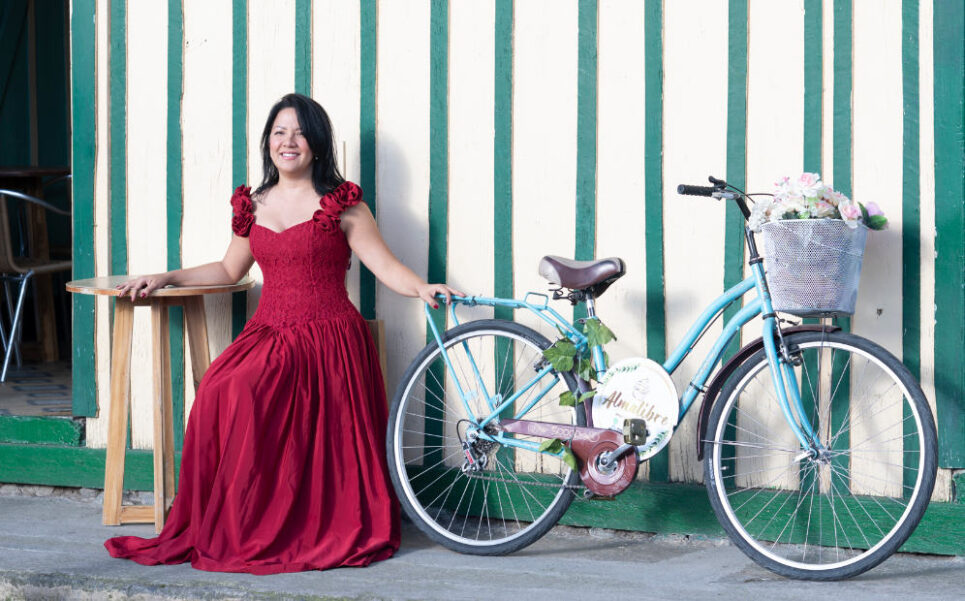
When art opens itself to others, it ceases to be mere expression and becomes possibility.
For Catalina Mejia, music does not end when the stage lights go off. It continues in spaces where art becomes an encounter.
Over the years, she has participated in projects with youth and children in Colombia, including her experience as a workshop leader in Clubes de Ciencia Colombia, an initiative supported by Harvard, MIT, and Colombian universities.

Working with children in the Coffee Region transformed her way of seeing the world.
They, she says, teach living in the present with more innocence and less pretense, keeping creativity alive, and flexing the adult mind.
This experience translates into her understanding of art.
For Catalina, artists have a responsibility toward society—not through imposition, but honesty. If platforms are not used to raise questions or point out injustices, art risks losing its meaning.
Her music does not dictate answers. It invites. It speaks of love, culture, resilience, and care for the planet. In this gesture, it becomes an act of collective care.
In the intersection of art and community, music ceases to be solely individual expression and becomes a shared gesture—a space where learning, listening, and creating coexist.
Perhaps one of the deepest dimensions of her work is understanding that each song is not only sung but also given—and in that act, art opens paths, sustains processes, and reminds us that even amid uncertainty, we can still build something more human together.
Looking Forward: New Cycles
Every creative process involves letting go and starting again. Each work shared with the world leaves something behind, but it also opens a new space, still uncertain, where questions begin to take shape again.

In Catalina Mejia’s trajectory, this movement is not rupture but continuity. While Los colores de mi ancestro continues to resonate on stages and in memories, another universe begins to unfold gently: Amores y flores, a live album recorded in Barcelona that will be released soon.
In this new work, love appears as a guiding thread, but not from a single or idealized idea. It is a love that expands, fragments, and reconstructs itself in multiple forms. Love for the essential, for what sustains life in the everyday: a hug, a glance, a shared moment.
It is also love for the earth, for clean air, for water, and for the small gestures that, when repeated, build a more conscious way of inhabiting the world.
In her voice, love ceases to be a concept and becomes a practice.
But it is also resistance.
In migrant contexts, in territories marked by distance and transformation, music—singing, dancing, creating—becomes a form of permanence. A place where identity is not lost but redefined.
From there, her intention is clear: for those who listen to this new album to feel accompanied.
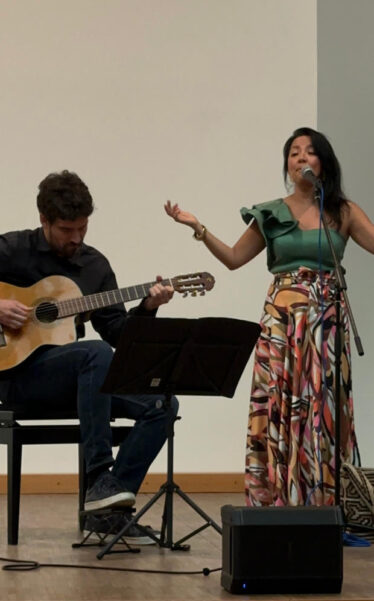
For them to find, even amid uncertainty, a space of hope.
So that they may celebrate, but also to allow themselves to reflect on forgiveness, justice, and the possibility of starting anew.
And above all, to live the music.
To dance. To let it move through them. To remember that we only have one ticket on this journey called life.
If her music could freeze time in a single image, it would be a luminous moment: Catalina Mejia smiling under a gentle sun, surrounded by her community, while a cumbia marks the shared pulse of that instant.
Because, at the heart of it, all her work originates there.
From the need to weave connections.
To build community.
To understand that behind every song there is not just a voice, but a network of affections, collaborators, and intertwined stories that make what we hear possible.
And there is also a silent certainty that runs throughout her journey: the conviction that creating is still a way of believing.
Believing in others.
Believing in the path.
Believing in the possibility of beginning again.
Final Reflections
Ultimately, the music of Catalina Mejia is not limited to being heard: it is experienced as a place to which one returns.
A place where memory does not weigh down but accompanies. Where roots do not immobilize but sustain movement. Where distance—whether geographic, emotional, or generational—finds a way to reconcile through sound.

Throughout her work, tradition and contemporaneity do not clash; they engage in dialogue.
Science and art do not compete; they complement each other. Migration does not fragment; it transforms. And love, in all its forms, appears as a force that runs through every layer of her music.
Imagine a Colombian sunset, a starry sky over Europe, the pulse of a cumbia that makes the body and heart vibrate.
Catalina invites us to inhabit these moments, to feel them with every note, every pause, every silence that breathes between melodies. Her music becomes a refuge, a space where joy, hope, and memory coexist.
But perhaps most importantly, it is not only in what she sings but in how she sings it.

In the way she builds from listening.
Creates from memory.
Shares from the collective.
Behind every chord is a network of affections: her father guiding, her husband accompanying, her sister supporting strategies, producers, photographers, musicians, and friends bringing each work to life. Every song is the fruit of that community, of that human fabric that turns music into resistance, celebration, and transformation.
In a time marked by speed, overproduction, and constant noise, her approach invites something different: pause. To listen attentively, to feel without hurry. She invites us to remember that even amid uncertainty, there are still spaces where the human remains intact.
In every song, there is more than a melody. There is a story unfolding, a bond being recognized, an emotion finding its place. And in that act—seemingly simple but deeply necessary—the music of Catalina Mejia reminds us of something essential: that we are still capable of listening to each other.