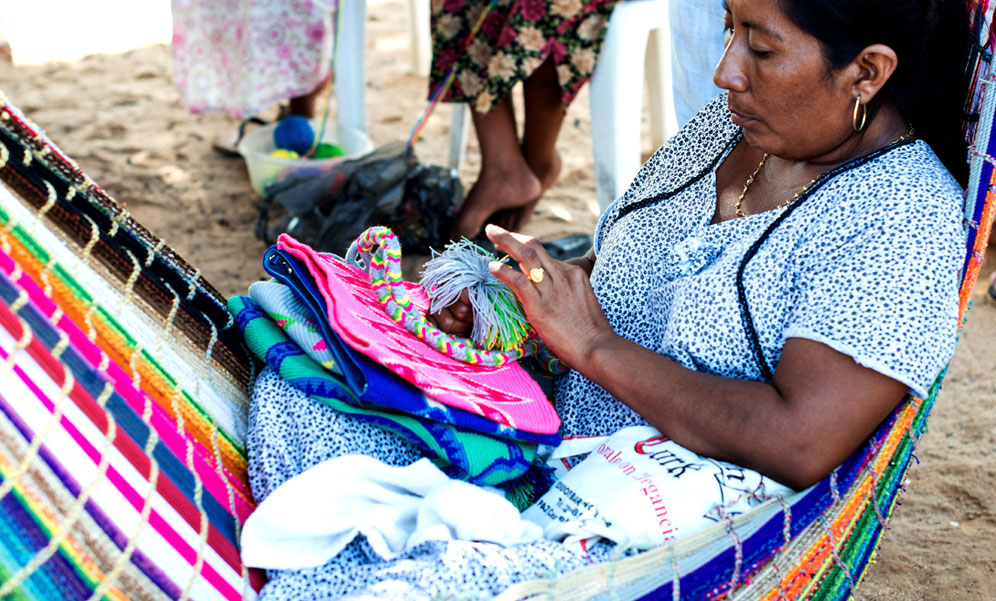
According to Wayúu culture, weaving is much more than a cultural activity. It is also a legacy passed down from one generation to the next. For the Wayúu, weaving is a way of giving life. It is a life experienced and expressed through their own hands.
The Inspiration Behind Wayúu Culture

The Wayúu achieve this through creativity, intelligence, and wisdom. That is why every mochila or handicraft they create is unique and original.
For the people who weave, threads are a sacred element. This is especially important within Wayúu culture.
This brings us to the story behind Fundación Hilo Sagrado in Colombia. The organization works with the Uyaraipa.
Fundación Hilo Sagrado was founded in January 2013 by Italian sociologist Sabrina Prioli. It all began when Prioli moved to Colombia. There, she fell in love with Wayúu culture.
After some time, she decided to create an organization to help improve the community’s quality of life.
The idea was to continue work that had already begun. After learning about the situation of Wayúu women, they decided to carry the project forward.
Just 365 days after founding the organization, Prioli began working together with sisters Ana María and Emilia Torres.
In January 2015, Sabrina decided that the Torres sisters would take over the foundation. They later brought a third person onto the team.
The three women behind its success are Natalia Bertel, Ana María Torres, and Emilia Torres. They are based in different countries.
For some reason, more women than men are involved in this project. This does not mean that men do not participate.
In our case, women have felt a need. We want to help women facing difficult circumstances.
Hilo Sagrado seeks to preserve the cultural heritage of Latin American communities. To achieve this, it focuses on empowering women.
This group of empowered women develops sustainable textile production. It does so by modernizing facilities and improving training.
It also seeks to incorporate clean technologies, ethical promotion, and social responsibility.
Challenges for Wayúu Culture
Indigenous and artisan communities across Latin America have passed down techniques and cultural traditions for centuries. Their practices also have profound social implications.
However, many Indigenous traditions are disappearing. This is happening as Western civilization continues to expand.
The central idea went far beyond personal satisfaction. It was about creating a sense of belonging and having a positive impact on someone else’s life.
As a result, the tradition of creating textiles with ancestral embroidery techniques could disappear.
One example of this situation can be found in the La Guajira desert. This region lies on the border between Colombia and Venezuela.
This territory is home to the Wayúu Indigenous community. The Wayúu are the largest ethnic group in Colombia and Venezuela.
They are autonomous and have protected their traditions from Western influences. Wayúu culture also fills La Guajira with color and meaning.
The Wayúu Indigenous community has managed to maintain a certain distance from the rest of society. It has also preserved many of its traditions and its own language, Wayuunaiki.
The women are tireless workers. They are also dedicated, wise, and disciplined.
Each woven design carries a meaning that goes beyond aesthetic beauty. The colors and designs are simply extraordinary.
Behind every mochila is a cultural message. There is also a part of the soul and history of the person who created it.

Wayúu culture is organized into clans. At birth, children take their mother’s surname.
For this reason, Wayúu women are at the center of the family. They are also cultural leaders.
Matrilineal descent means that family lineage is established through the mother’s line.
Wayúu Handicrafts
We have learned so many things from this community. They have had the best attitude toward improving their quality of life.
A traditional Wayúu settlement consists of five or six “rancherías.” Each ranchería is named after a plant, animal, or place.
Each territory that brings together several rancherías takes the surname of a woman. In this way, a matriarchal structure is maintained.
In this context, the challenge is significant. Artisan projects can become valuable tools for development.
At the same time, these projects establish economic and social goals. They generate income and reinforce cultural identity.
Traditional handicraft production also does not require machinery. It generally uses materials that are easy to find.
This makes it possible to create employment for other members of the community.
Handicrafts are generally made at home alongside other daily activities.
For many Indigenous communities, organizing work competitively can be difficult. However, this type of organization can generate significant benefits.
Profits from handicraft sales can finance other activities. These can contribute to local community development.
Ultimately, that development is one of the main objectives.

One of the most important aspects of Wayúu culture is the weaving of mochilas by women.
But that is not all. Latin America and the Caribbean preserve enormous cultural and natural wealth.
From pre-Hispanic archaeological sites to natural landscapes, there are resources for sustainable development. However, this potential is not always fully utilized.
The community is incredibly welcoming. They received her with open arms. There are many cultural differences that you would never imagine.
You may think that as a Colombian you know about Wayúu culture, but in reality, you don’t.
The global economy continues to face different challenges. At the same time, efforts are being made to promote a new industrial revolution.
This revolution must be sustainable and inclusive. That means growing while taking the planet’s limits into account.
It also means putting people at the center of development.
However, making this a reality is more difficult. Sustainable industrial development requires taking advantage of women’s economic potential.
Women represent half of the world’s population. Their participation is therefore essential.
Hilo Sagrado and Wayúu Culture
The Hilo Sagrado team firmly believes in giving back to the Wayúu Indigenous community. It is also part of the fair-trade movement.
The Wayúu community is committed to the sale of 100% Wayúu mochilas and handicrafts.
However, the work of Fundación Hilo Sagrado goes much further. It seeks to preserve the cultural heritage of Latin American communities.
It also seeks to empower women. The idea is to develop sustainable textile production.

To achieve this, the foundation provides training and supports modernization. It also works to improve infrastructure for textile production.
One of its objectives is to promote the use of clean technologies. It also supports ethical production and social well-being.
Fundación Hilo Sagrado uses creative and interdisciplinary methods. Its goal is to promote sustainable development.
Together with local communities, it develops projects to improve quality of life. It also works toward achieving long-term goals.
For the foundation, working with women is vital. After all, they are the driving force.
Women are and will continue to be drivers of development. When equality exists, economies can develop more quickly.
Poverty also decreases. At the same time, the overall well-being of communities increases.
A Vision for the Future of Wayúu Culture
Hilo Sagrado has a clear vision for change. Its goal is to promote sustainable textile production.
This production must meet ethical standards. It must also allow communities to preserve their culture and identity.
Every Wayúu mother teaches her daughter how to weave. In this way, she keeps the tradition alive.
For Wayúu culture, weaving is a symbol of wisdom. It also represents intelligence and creativity.
Women are at the heart of Wayúu culture. They are strong, respected, and deeply important figures. Men have certain roles, of course, but women are the heart of this Indigenous community.
According to legend, the tradition of weaving mochilas comes from Wale’kerü. She was a spider who taught women how to create their designs.
Every design is unique to the person who weaves it. The colors, patterns, and shapes tell a story.
The weaver pays special attention to the way that story is told. This allows the mochila to faithfully represent Wayúu culture.
At first, La Guajira may appear monochromatic. Beige desert tones and gray thorns dominate the landscape.
Here, sunsets are painted blood red.
Wayúu women work entire days while weaving their mochilas. Completing a single piece can take a whole month.
Today, Wayúu mochilas represent an important source of income. These resources allow many families to maintain their way of life.
Women’s empowerment is crucial to the Indigenous community. It is also important for women around the world.

When women generate income, they can build assets. This increases their economic security.
Women also tend to have a lower environmental impact. Their patterns of consumption and production can be more efficient.
When they participate in economic decision-making, they generate positive effects. These can contribute to the development of a sustainable economy. Today, this process continues to develop within the Colombian Wayúu community. It is a process built with one Sacred Thread at a time.