The Wall of Shame is what many people know it as. Indeed, as if it were not enough after the world was absorbed by WWII, Germany and its capital city were divided by the BERLIN WALL.
In this context, a wall that put on display the differences amongst the Allies, the foursome that won the war and freed the world from the National Socialist dictatorship that was bringing down all types of people.
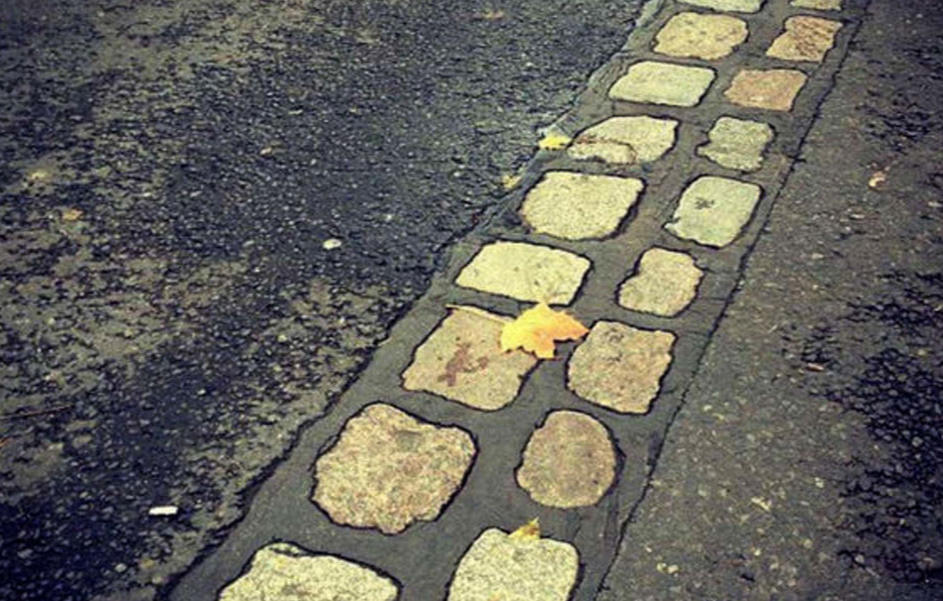
The division
Although the entire country was divided into two — the GDR (the German Democratic Republic; socialist, East Berlin) and the FRG (the Federal Republic of Germany; capitalist, West Berlin) — the German capital, the capital of the defeated country, undoubtedly suffered one of the hardest separations.
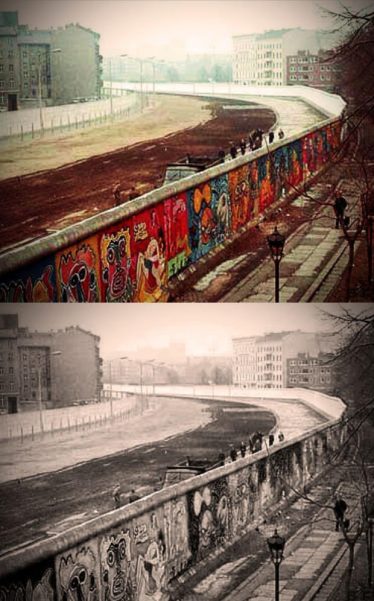
Not only because it was divided amongst the victorious, but also because this city had a physical boundary: the BERLIN WALL.
Consequently, the nightmare began on August 13th, 1961, a date on which the GDR government demanded the closure of borders with West Berlin. To make matters worse, the wall was constructed overnight.
Laura Viera A: Luis Eduardo, do you have friends who lived through that separation with their families?
Luis Eduardo Solano: Yes, I still keep in touch with some of them. They say that they went to study that day, and when they wanted to return to their homes, they could not do so because of the wall. After a few years, when the situation “normalized” a little, they could go to visit their parents for a few hours, but then they always had to return to West Berlin.
Shortly after, on August 22nd, the GDR’s Interior Minister organized seven crossing points for cars and one for trains that inhabitants from West Berlin and the FRG could use.
As a result, crossing was prohibited for most citizens on both sides. In order to do so, it was necessary to belong to the same city, have proper documentation, and go to one of the many official crossing points along the BERLIN WALL.
Laura Viera A: How was the process of crossing the border for you?
Luis Eduardo Solano: Well, I came as a student on an exchange program between the University of Tunja and the Technical University of Berlin, so I had a permit that allowed me to cross to the eastern side without any problem. However, I must say that they looked at you a lot, they checked your documents excessively, asked a thousand questions, the GDR guards were aggressive, they tried to take advantage of you, and it was very stressful to cross.
It took them 30 years
Finally, 30 years later, the people got what they wanted: freedom within their own country. On the night of November 9th, 1989, a little before 7 pm, Günter Schabowski, who was the General Secretary of the Socialist Unity Party, announced during a press conference a new set of regulations under which East Germans would be allowed to cross the border along the Berlin Wall with proper permission.
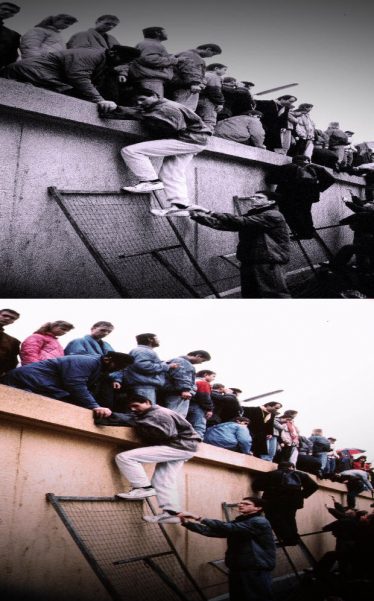
However, this turned out to be one of the biggest bureaucratic mistakes in history.
People could not stand it anymore. There was too much repression.
Nearly three decades of torn families had passed. As expected, people demanded change. They did so persistently, refusing to give an inch, yet always in a peaceful manner.
Earlier, on November 6th, a draft law regarding border traffic had been presented. Its goal was to reduce the growing exodus into Czechoslovakia.
“I did not give birth to my children so that they wouldn’t know freedom, trapped and without options.”
Nevertheless, this law was not enough. During demonstrations in Leipzig and Berlin, it became evident that people were not satisfied with the new regulations.
The news spread like wildfire
Subsequently, these regulations were revised on November 9th and included changes regarding visits. In theory, people would be granted special border crossing conditions and visas for private travel.
What followed during the press conference was decisive. Schabowski, General Secretary of the SED, announced the regulation prematurely. At that exact moment, communication errors occurred, and he explained to a journalist that it was possible to travel “without any special conditions, the motive for the trip, or family ties.”
Moreover, he assured that the regulations would come into effect immediately: “As far as I know—effective immediately, without delay.”
Schabowski’s declaration became what Germany’s first national news channel called the most important news of the day: “The GDR opens its borders.”
Laura Viera A: What exactly happened?
Luis Eduardo Solano: As we have discussed, it was a human error. Günter Schabowski could not find an answer to the journalist’s question during the press conference. At that moment, he answered that as far as he understood, this decree was effective immediately. And the rest is history. Within a few minutes, everyone had heard the news and began to arrive at different points along the wall.
As a result, the news spread like wildfire. As the hours passed, thousands of East Berliners moved toward the six border crossings. Nobody expected it; after all, the statement was a mistake — a misunderstanding.
Meanwhile, border guards did not understand what was happening. The situation was, at best, unclear. As the night progressed, people pressed toward the other side of the 3.6-meter-high wall, reinforced with 41 miles of barbed wire that divided Berlin, Germany, and the world.
The crowd vastly outnumbered the guards. Importantly, no one was willing to order lethal force. Finally, at 11:30 pm, Stasi officer Harald Jäger decided to open the gates and allow people into West Berlin.
“We were at a birthday party and after a while, they told us that the wall fell down. For us the decision was simple: we would celebrate on the streets. We went to the nearest border crossing point and we crossed it. The idea was to go to Alexanderplatz, but halfway there we met someone from the other side of the wall and we went to their house and continued to party there”, says Andreas with a chocked voice.
On the other side of the border, crossing points were multitudinous. Meanwhile, around 11:30 pm, the crowd had grown so large that the official responsible for border control, still unaware of any clear instructions from above, decided to open the gates. “It is a day I will never forget. It changed my life,” says Katerina.
What followed was extraordinary. Around 20,000 people crossed over the Berlin Wall at the Bösebrücke bridge alone. Shortly afterward, the remaining border controls opened throughout the night.
Laura Viera A: Where were you when the wall fell?
Luis Eduardo Solano: At that time, I was working in a hamburger restaurant; it was a student job. When I was returning home, and I was in the subway, I began to realize that there was something different in the environment. At the time, I didn’t know what was going on, and when I got to my girlfriend’s house, she told me what was going on, and we went out to xxxx. That place was already full of people, a lot of people. Then we went to another part of the wall. There was no one from the western side, very few from the eastern side, but slowly they started to arrive.
Laura Viera A: And what happened next?
Luis Eduardo Solano: Well, at that moment, while everyone wanted to enter the western side, I wanted to see the eastern side. I entered through a corner, and I was going against the flow of people. At one point, I realized that I was surrounded by a lot of young people, and the plan was to go to the Brandenburg Gate, and after a while, they started to say that we should be careful because they were shooting. I made a decision, I didn’t know what was going to happen, and I didn’t want my physical integrity or my residence permit to be affected.
Ultimately, due to the peaceful revolution in the Federal Republic of Germany and the profound changes taking place across Europe, the Berlin Wall fell that night. Remarkably, none of the 31 border controls, the 640 trained dogs, or the 1,400 soldiers managed to stop the crowd that was determined to claim its freedom.
In the days that followed, the entire city was immersed in moments of collective joy. A party-like atmosphere floated through the streets. “It was a collectible happiness; our hearts were rising,” remembers Andreas.
Over the course of the following days, the border opened all around the city. Finally, on December 22nd, the border control at Brandenburger Tor was lifted. The demolition of the Berlin Wall, which had cut the city in half for decades, took place between June and November 1990.
Its memory is alive
Today, whoever is interested may follow more than 20 kilometers of the former course of the Berlin Wall that is marked by a double row of paving stones. Without a doubt, Bernauer Straße 111 is the best place to see and understand what the Berlin Wall used to look like, the width of the bordering strip, and the construction of the many frontier posts.
Even though the Berlin Wall disappeared, its memory is alive. Many are shocked by the fact that there are so few remains, there are actually few sections, and some watchtowers still exist at Postdamer Platz, Bernauer Straße, or East Side Gallery.
It was inhumane to “lock us down” like that – Andreas
Unquestionably, the remains of the border crossing points have lost all their horror and terror overtone. One of them, and perhaps one of the most recognizable,d is Check Point Charlie.
In a very German style, historical memory is a subject that they manage perfectly. They are aware of the gruesomeness the National Socialists caused, the suffering they put their own people through, the repression, frustration, and division that resulted from the Wall. Because of this, the places commemorating those who died and suffered along the Berlin Wall invite us to meditate in order to understand what really happened.
A special reunification celebration
In order to celebrate the reunification of the city and country, Berlin was once again a divided city.
Eight thousand white balloons made a 15 kilometer light bounding line from November 7th until the 9th.
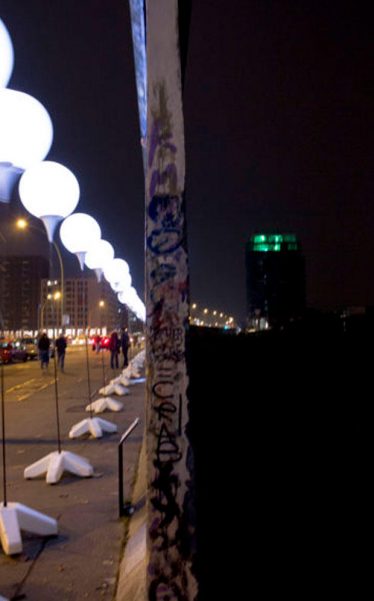
They were released into the night sky, carrying messages of hope. Carrying messages of reunification so that such a tragedy doesn’t repeat itself.
There were screens in different parts of the city playing scenes from the Pacific Revolution before the fall of the Wall.
The idea was that all the people, all generations, could see what took place and the repression that they lived in.
At that moment in time, people remembered the hundreds of children pleading with others not to take their mothers away, others in jail because they voiced their opinion, continued clashes with the police, and desperate and scared people.
Even as they were completely aware of the situation they were immersed in, women and men all over Berlin and Germany made part of the peaceful revolution and shouted: we are the people!!!!
The feelings and emotions due to the celebrations held were running high; it was a once-in-a-lifetime experience, unrepeatable.
The Wall
I deeply admire the germans and people might immediately think that they should be admired because of their strong economy, their government, and their efficiency. But, after living here for more than a decade, I admire them because, aside from all those wonderful characteristics, they rebuilt their own country and society.
They were able to overcome the hate. They managed to tear down a wall, not only the built wall that was seen in Berlin, but also felt all over the country. They tore down the wall that separated their families, their friends, their lives.
I wasn’t born when the Berlin Wall was built. I was underage and lived on a different continent when it came down. Today, many years later, I am here. I live in a country that was divided and in a city that was imprisoned.