Arriving in the historic city of Erfurt does not produce an immediate impact. There is no grand gesture, no postcard image that demands attention. Instead, there is something rarer: a sense of continuity. It feels as if the city does not present itself outright, but rather allows itself to be discovered slowly.
Walking through its old town unfolds without interruption. The streets do not appear designed for visitors, but for everyday life. For me, that changes everything. It invites us to lower our voices and observe more carefully. The historic city of Erfurt is not a place to rush through. It is a place to move through, deliberately.
The Historic City of Erfurt
The first thing to do is to situate oneself. Erfurt lies at the geographical center of Germany, in the federal state of Thuringia, of which it is the capital. This is no minor detail. For centuries, this position turned the city into a natural crossroads of trade routes between eastern and western Europe. Goods passed through here, along with languages and beliefs. Tensions as well.
The historic city of Erfurt holds more than a thousand years of documented history. During the Middle Ages, it was one of the most prosperous cities of the Holy Roman Empire, known for its trade in woad—the plant used to produce the blue dye that clothed half of Europe. That early wealth left its mark. Churches, monasteries, and civic buildings overlap without ostentation and continue to define the city’s silhouette.
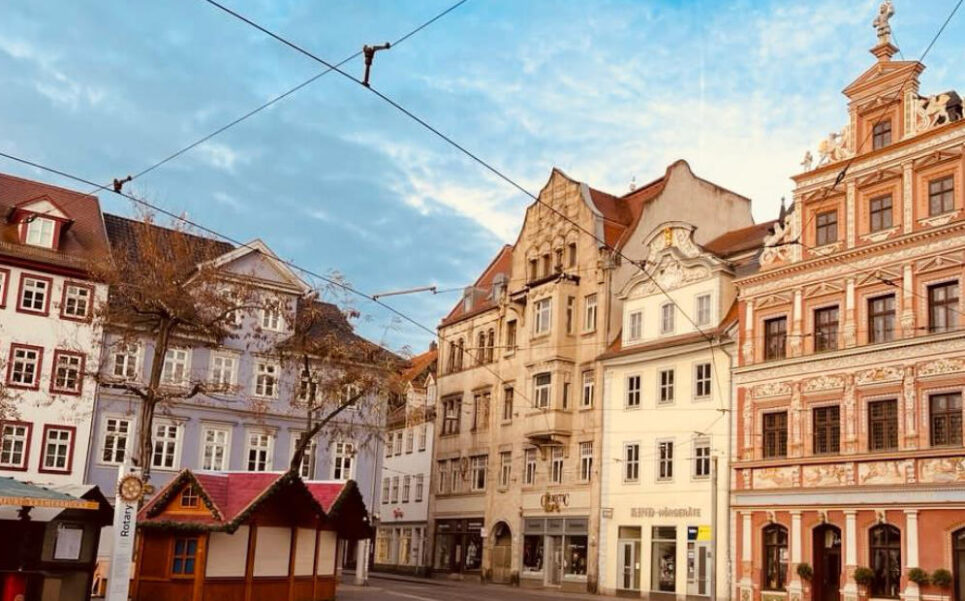
But Erfurt was not only an economic hub. It was also an intellectual center. At the end of the 14th century, one of the oldest universities in the German-speaking world was founded here, attracting students from across the continent. Among them was a young Martin Luther, who arrived long before becoming a symbol—when he was still searching for answers rather than ruptures. The city did not trade only in goods: it produced thought.
The university appears without announcement. It does not impose itself as a separate campus but reveals itself gradually while walking. Founded in the Middle Ages, closed in the 19th century, and reopened after German reunification, its history is discontinuous.
Ancient and young at once. That duality is palpable in its atmosphere: silent libraries, medieval manuscripts, research centers in dialogue with the present. Here, knowledge is not accelerated. It settles.
This sense of continuity has another key explanation. Unlike many German cities, Erfurt was not a primary target during the Second World War. It was neither a major industrial nor a military center, which spared it from large-scale bombing. The result is visible. An old town that was not reconstructed to look old, but simply remained standing. Narrow streets, inhabited bridges, squares that still fulfill their original function.

Today, the historic city of Erfurt is known for this rare balance between historical density and human scale. It does not seek to compete with major metropolises or chase headlines. It moves on a different frequency. A city where the past is not exhibited—it accompanies.
Erfurt cannot be reduced to a single gesture. Not to a tower, not to a proper name, not to a key date. Its history does not advance in a straight line. It folds, seeps through, and appears at the margins. And it is from there that it begins to be understood.
The Historic City of Erfurt and Its Living Past
In the historic city of Erfurt, the past is not sealed behind glass. It appears on street corners, in walls, and in the names of streets themselves. Most notably, it lives on through the city’s medieval Jewish heritage, now recognized as a UNESCO World Heritage Site.
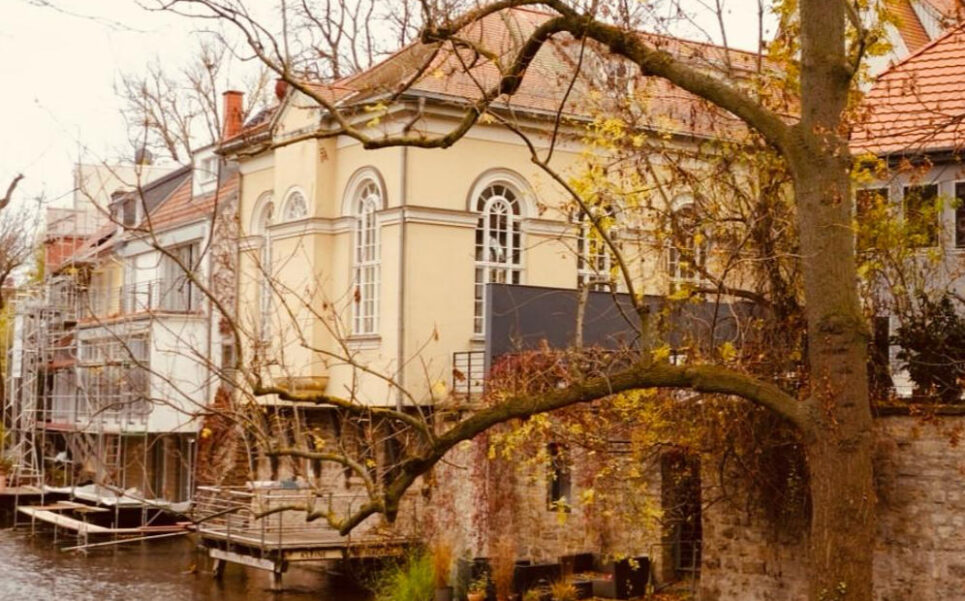
Importantly, the strong Jewish presence in Erfurt was no coincidence. From the late 11th century until the mid-14th century, the city was home to one of the most significant Jewish communities in Central Europe.
Likewise, the ensemble known as Jewish-Medieval Heritage Erfurt—the Old Synagogue, the medieval Mikveh, and the so-called Stone House—does not operate as a conventional tourist circuit. Instead, it is woven directly into the urban fabric. You encounter it almost without realizing. This integration, rather than separation, heightens both the beauty of the place and its people.
The Old Synagogue, one of the best-preserved in Europe, impresses through restraint. It does not seek to dazzle.
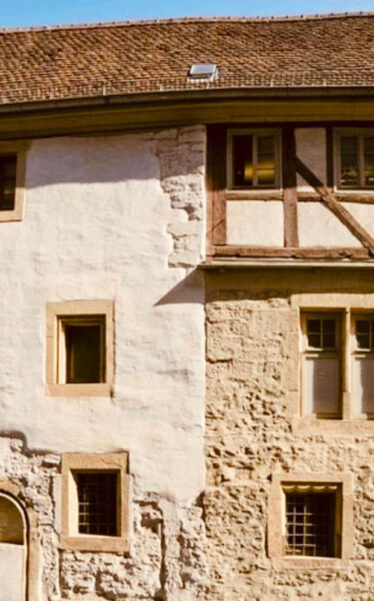
From the outside, the Erfurt Synagogue remains discreet, almost austere, as if still guarding its intimacy. Inside, however, layers of time unfold: thick stone walls, traces of arches, and evidence of changing uses across centuries.
Without hesitation, it stands as one of the best-preserved medieval synagogues in Europe. Crucially, this is not because it has been frozen in time, but because it has adapted without disappearing. Walking through its interior means traversing a history that was interrupted and, at the same time, reclaimed.
The Mikveh, built in the 12th century, reveals itself as a space of depth and silence. As a Jewish ritual bath used for purification, it bears witness to an active and organized community deeply rooted in everyday life. Even today, gazing into the depths13 of its waters creates an involuntary pause.
Here, history does not shout. It suggests.
Moving through these spaces feels less like visiting a museum and more like stepping into continuity. What endures is not only stone, but the memory of those who lived here, unaware that centuries later others would come to listen for their echo.
The city of Erfurt from Above
After exploring spaces that invite inward reflection, the body naturally seeks movement. The historic city of Erfurt does not end in intimacy. It also unfolds outward. Almost imperceptibly, the path begins to rise.
Some cities are best understood from above—not for control, but for perspective.
In Erfurt, ascent is neither symbolic nor abrupt. It is physical, unhurried, and almost ritualistic. Each step prepares the visitor for a shift in perception.
At a certain point, the historic city seems to rise—or rather, one climbs toward it.
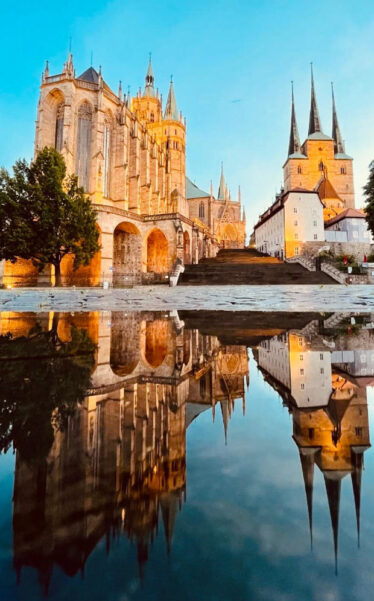
The steps leading to St. Mary’s Cathedral and St. Severi Church mark a clear transition. As the body ascends, the gaze adjusts.
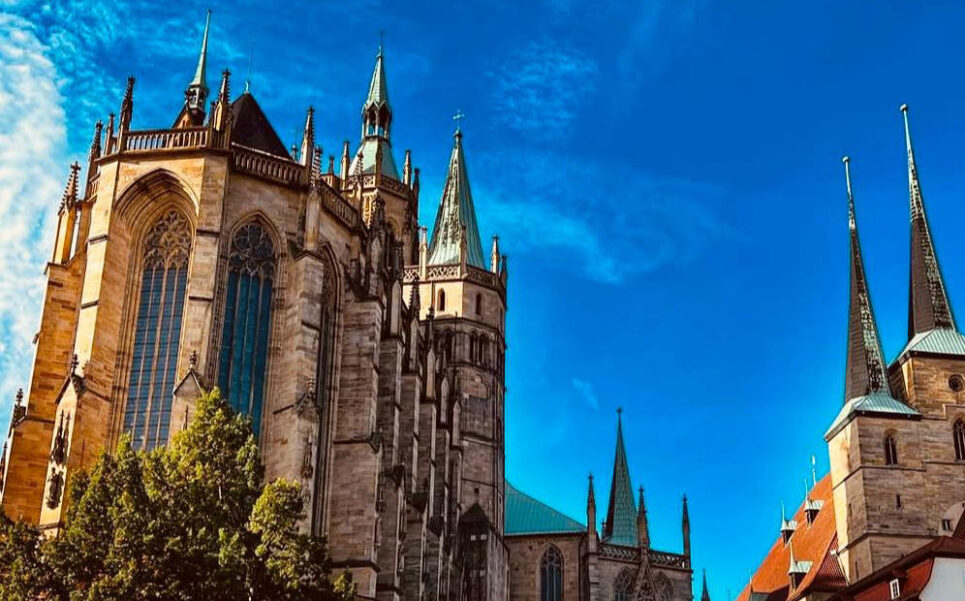
St. Mary’s Cathedral and St. Severi Church do not confront each other; they converse. They share height, stone, and silence, yet maintain distinct characters.
The cathedral asserts itself through the verticality of its Gothic choir and the weight of its centuries. By contrast, St. Severi opens with a calmer, almost welcoming breadth.
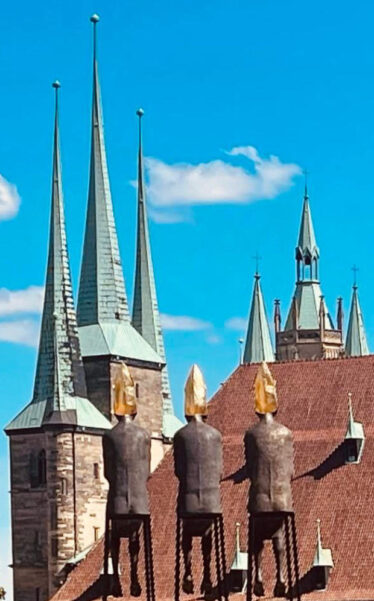
Between them, the space does not divide—it connects. Bells mark the rhythm of the day, while life continues around them without forced solemnity. Here, monumentality does not intimidate. It accompanies.
At certain hours, sound takes precedence over sight. Bells overlap rather than compete—one deep, another lighter. Their echo descends the steps and disperses across the square.
Footsteps, low voices, wind brushing against stone. Everything happens without announcement.
The historic city of Erfurt listens to its own pulse and moves forward, as if this ancient dialogue belonged fully to the present.
From above, Erfurt orders itself without becoming small. Past and present coexist without rivalry. Descending once more, something has shifted: the pace slows, attention opens.
Luther, Silence, and Contradiction
After height and stone, the historic city of Erfurt proposes a quieter turn—more inward, more restrained. The city cannot be understood only through what rises, but also through spaces where thought withdraws. Not everything here speaks loudly. Some of the most decisive places prefer a whisper.
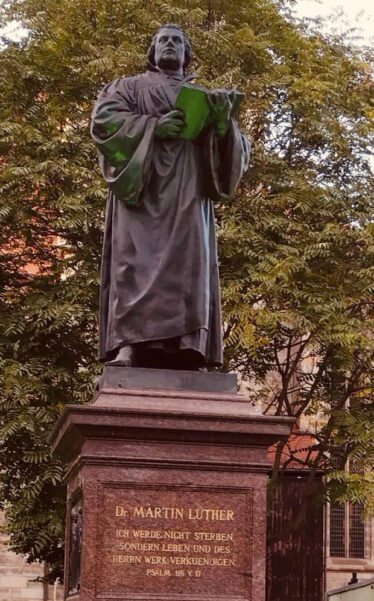
If the cathedral speaks of spiritual authority, the Augustinian Monastery murmurs inner conflict. It does not impose itself. It offers itself.
The walk there is brief and ordinary, yet the shift is immediate. Within minutes, the historic city of Erfurt lowers its voice. The monastery’s walls do not seek height or spectacle. They receive.
It was here that Martin Luther lived as a monk, celebrated his first mass, and confronted a restlessness that found no peace. Erfurt was not the stage of the Reformation, but it was where the conflict began to take shape. Within these walls, faith ceased to be certainty and became a question.
The atmosphere remains intact. Corridors are sober, light enters cautiously, and silence is not absence but presence. There is no triumphant narrative, no definitive resolution—only a persistent sense of searching.
Today, the monastery does more than recount a biography. It is a space crossed by ideas: faith, guilt, conscience, and individual responsibility. The permanent exhibition avoids epic tones and embraces complexity. Outside, the city continues. Inside, time stretches.
The Augustinian Monastery does not ask for admiration. It asks for silence. And within that silence, the historic city of Erfurt reveals itself once more as a place where transformation is born not from noise, but from doubt.
Eating, Pausing, Observing
Every city needs moments of rest. After walking its streets and listening to its layered history, the body asks for something simple: to sit, to eat, to observe.
In the historic city of Erfurt, these moments are not interruptions, but essential parts of understanding the place.
Traveling is also eating. And here, food is not spectacle—it is a shared routine.
Traditional taverns offer simple, comforting dishes: schnitzel, dumplings, and seasonal soups. Nothing pretentious.
Everything familiar. For families, this matters. Menus are accessible, and spaces feel relaxed.
Bakeries, meanwhile, deserve a pause of their own. Enter without hurry, choose something sweet, and sit near a window. These small gestures ultimately define the journey.
The Historic City of Erfurt as a Family Destination
Not all cities are kind to childhood. Some demand constant vigilance; others impose unfamiliar rhythms that exhaust more than they inspire. The historic city of Erfurt, by contrast, feels instinctively shareable. Not because it is designed for children, but because it respects human time. It allows pauses. It leaves room.
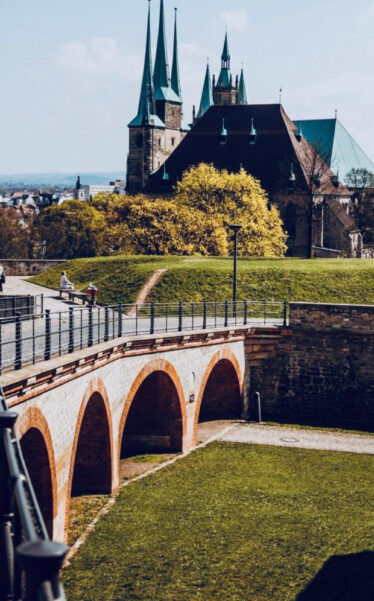
Traveling with children often requires careful planning, lists, and contingencies. Erfurt suggests the opposite approach: trust. Trust in space, in rhythm, in the way the city reveals itself without pressure. The streets are calm. The scale is manageable. Nothing feels rushed or oversized.
One of the great strengths of the historic city of Erfurt is its walkability. Distances are short, and the historic center limits traffic in ways that change how the city is experienced. Walking becomes the default, not an effort. Parents relax. Children wander. The city adapts to the family, not the other way around.
This ease reshapes the day. There is no need for rigid schedules or constant negotiation. You step outside, choose a direction, and let the route unfold. A bridge becomes a pause. A square turns into a place to linger. A canal invites questions.
Families can discover little adventures everywhere: watch the Krämerbrücke’s colorful shops and imagine the stories behind each façade, or pause at one of the city’s small parks while children chase leaves or feed ducks along the Gera River.
The Petersberg Citadel offers not only history but wide open spaces where kids can roam while adults take in the panoramic views. Even stopping at a bakery to choose pastries becomes a small ritual of exploration—learning patience and taste all at once.
For something playful and slightly magical, the eggshell-painted windows of the old town’s historic houses often capture children’s attention—inviting them to spot patterns, colors, and hidden figures as they wander.
A visit to the Thuringian Zoo nearby gives a quiet interlude where animal sounds replace the cobbled streets, letting energy run free while still feeling safe. And the Augustinian Monastery’s gardens provide secret corners to explore, imagining the monks’ footsteps centuries ago, giving young minds a tangible connection to history.
Bridges, small plazas, water, and softly colored façades offer constant stimulation without overload. The city engages curiosity without demanding attention. History, architecture, and everyday life mix naturally. Learning happens almost unintentionally, absorbed through movement rather than explanation.
Here, the city educates without announcing itself. It teaches how to look, how to walk together, how to wait. And for a shared family experience, that quiet generosity is worth far more than any attraction designed to impress.
Why Erfurt Is Different
Erfurt does not compete for attention, nor does it chase headlines. It does not aspire to be the most photographed or the most visited. Its singularity resides elsewhere—quieter and more enduring.
The historic city of Erfurt preserves its memory without turning it into scenery. It integrates UNESCO recognition naturally, without disturbing its daily rhythm. Above all, it allows those who walk its streets to merge—if only briefly—into a pace that does not accelerate to please.

Beyond monuments and contemplative spaces, Erfurt continues to breathe in the everyday. Here, history is neither fixed nor closed. It circulates, accompanies, and blends with daily life. In this balance, the city reveals itself not as an open-air museum, but as a place where the past remains open.
In the end, the historic city of Erfurt is remembered not for a single image, but for a lasting sensation: having walked slowly, refined one’s gaze, and understood that sometimes traveling does not mean going farther—but learning to look better.