Writing about Liliana Martinez again does not mean returning to a starting point; instead, it acknowledges that time has passed and left visible marks. At Solkes, Liliana Martinez has been introduced before, yet people—much like art—are never static. Over time, they change, sometimes expanding, at other moments withdrawing, and eventually blooming once more. From that understanding, this text is born. In other words, it emerges from continuity rather than repetition. It is not a formal presentation; rather, it unfolds as a resumed conversation.
When Liliana Martinez arrives, she does not rush. First, she greets. Then, she smiles. After that, she pauses for a second before sitting down. That small gesture says a lot about her. Because of this, there is a particular way of being present that cannot be learned. It must be embodied. At that moment, I think that the muralism of Liliana Martinez begins long before the wall. More precisely, it begins in her attentive way of inhabiting spaces and people.
From there, from that closeness without artifice, the dialogue begins.
Creating Far from the Place of Origin
Living in Germany has been more than a change of country for Liliana Martinez. Instead, it has been a process of definition.
Therefore, I ask how her artistic life has evolved since our last conversation. Her answer comes without detours. Yet, it arrives with depth.
Laura Viera A: How has your life as an artist changed in Germany?
Liliana Martinez: It has grown tremendously. Above all, I believe much more in using art as a tool to make visible causes that matter to me and resonate with me, as a woman, a migrant, and an artist.
There is something powerful in that clarity. At this point, the muralism of Liliana Martinez is no longer understood only as an aesthetic practice. Instead, it becomes a clear stance.
Germany, with its structures, rhythms, and social tensions, thus becomes a stage where the work of Liliana Martinez finds new challenges. At the same time, it also brings new responsibilities. Creating far from one’s origin forces constant questions. Namely, from where do we speak? And to whom? That question, in turn, runs through all of Liliana Martinez’s current work.
Painting with Intention
Naturally, the conversation moves toward her creative process. On the one hand, we talk about evolution. On the other hand, we talk about technique. We talk about time. Still, Liliana Martinez always returns to the same point: meaning.
There is no obsession with perfection in her. Instead, there is a deep need for clarity.
Laura Viera A: What transformations has your work undergone in recent years?
Liliana Martinez: The quality of my line has improved a lot. Above all, my confidence has grown. I do not want to be the best artist in the world. Rather, I want the message to be understood, clearly and strongly. For this reason, I focus on art as a tool, not as an end.
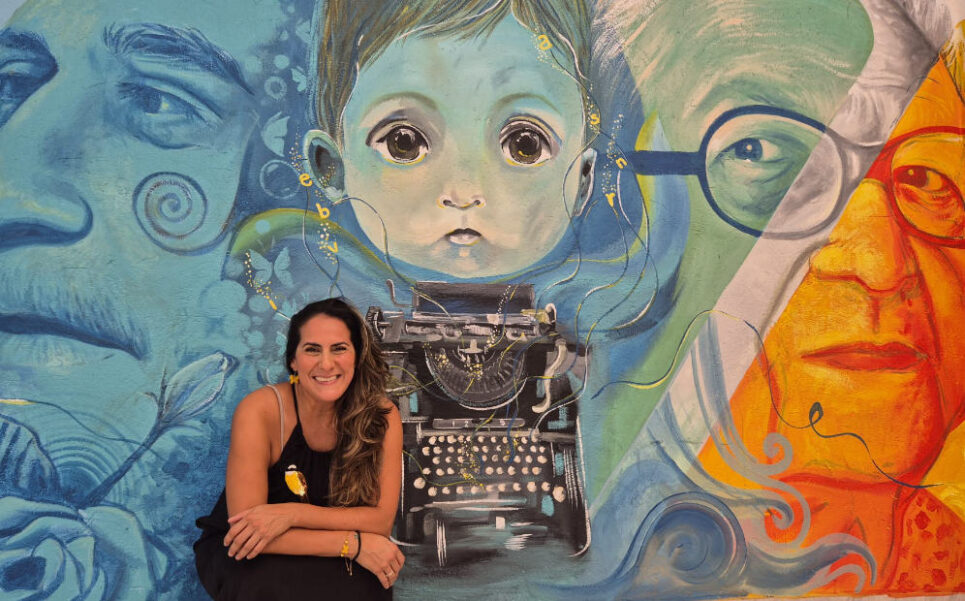
As I listen, I realize this choice is not minor. Especially in a context that pushes constant visibility, immediate recognition, and ego as a creative engine, Liliana Martinez chooses purpose.
In this sense, the muralism of Liliana Martinez is built on the idea of service. The artwork does not end with the artist who signs it. Instead, it is completed by those who live it. Because of this, many projects by Liliana Martinez are collective. They are open. Moreover, they are designed to be appropriated by the community and transformed by it.
From there, the step into public space becomes inevitable.
Consequently, I ask how her murals interact with German urban environments. Her answer arrives with a sincere laugh. On the surface, it lightens the conversation. Yet, it says more than it seems.
Laura Viera A: How do your murals dialogue with urban space?
Liliana Martinez: I don’t know if they dialogue. Perhaps, they might shout instead, through color. They shake the environment a little. They spark curiosity. At the same time, they create a sense of belonging by involving the community: Germans, migrants, refugees, children, young people, and older adults.
Color, in the work of Liliana Martinez, does not ask for permission. First, it appears. Then, it transforms. The muralism of Liliana Martinez breaks into spaces often designed without emotion or narrative.
In doing so, it turns them into meeting places. As a result, it activates memories, questions, and conversations. It does not impose a closed message. Instead, it opens a field of possibilities where each person finds something of their own.
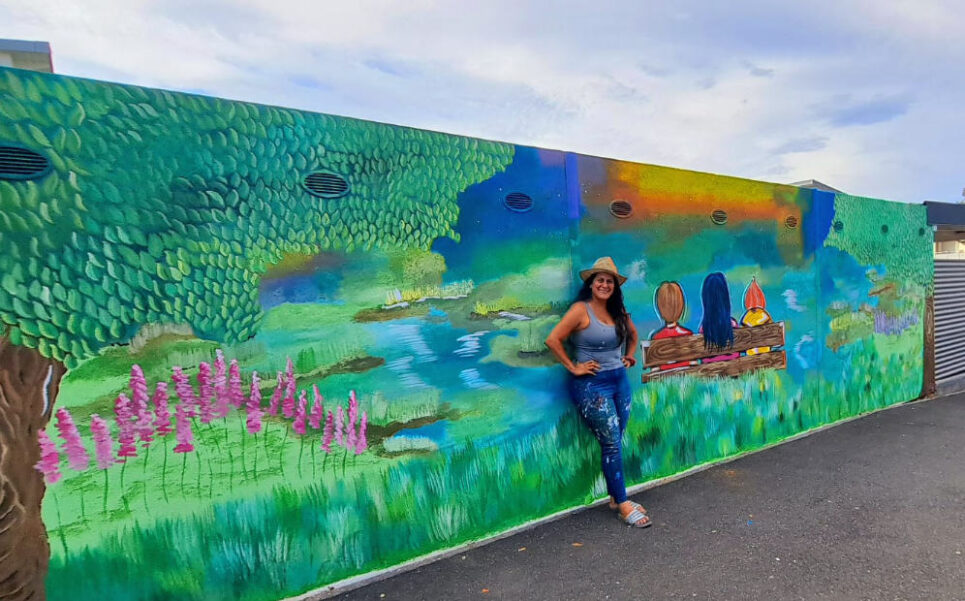
This ability, to activate others and to create connections through color and presence, is deeply linked to her migratory experience. At the same time, it is tied to how she has learned to look at the world—and at herself—with empathy.
That gesture, painting so that others recognize themselves in the work, does not come from strategy. Rather, it comes from lived experience. Color, collectivity, and the occupation of public space are not isolated decisions in the muralism of Liliana Martinez. Instead, they are consequences of a personal journey marked by displacement, listening, and the need to find a place in the unknown.
From there, painting stops being only creative. Gradually, it becomes a form of constant learning. Ultimately, that journey—migration and reconstruction—opens the next conversation.
Migrating to Learn: Migration and Identity in the Muralism of Liliana Martínez
Talking about migration with Liliana Martínez means entering an intimate territory. Not from drama or forced epic narratives. Instead, from the clarity that only years lived far from the familiar can offer. Migration, once it ceases to be new, becomes a permanent state. It becomes a way of being in the world. A way of observing and relating. A way of measuring time and affection. Listening to Liliana Martínez inevitably leads to recognition.
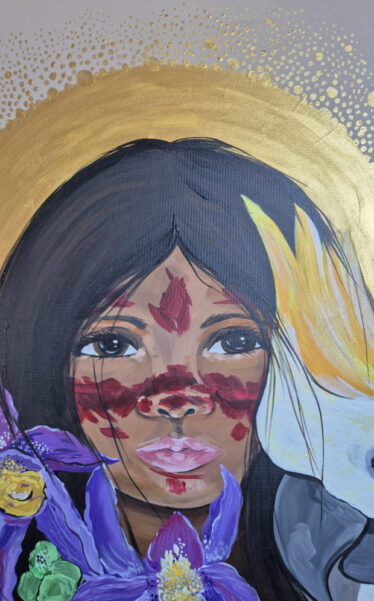
I understand what it means to migrate. Living outside Colombia since late 2006, and in Germany since 2010, has taught me that migration is not a single event.
At its core, migration is a daily decision—one that does not only occur on the day a border is crossed, but rather unfolds continuously. It emerges upon waking and extends through speaking, raising children, working, and, ultimately, creating.
In this context, migration means learning to inhabit absence without romanticizing it, while also building a sense of home within the provisional. At the same time, it involves accepting that the heart often lives in two places at once, held in a constant state of tension.
Naturally, this process is not easy. Instead, migration requires reinvention without guarantees and demands learning new codes alongside new ways of naming the world. Moreover, it calls for sustaining identity without allowing it to become either an anchor or a costume.
Over time, this becomes a constant exercise in adaptation, listening, and silent resistance. From this shared experience, the conversation with Liliana Martínez gains another depth. Consequently, we no longer speak from theory or discourse; rather, we speak from lived experience.
Laura Viera A: How do you live migration?
Liliana Martinez: Migration has been a part of my life since I was very young, not only in the form of international migration. I left my country at nineteen. It is always a challenge. But I also believe it builds a part of the human being that would not appear otherwise. For me, that part is self-knowledge.
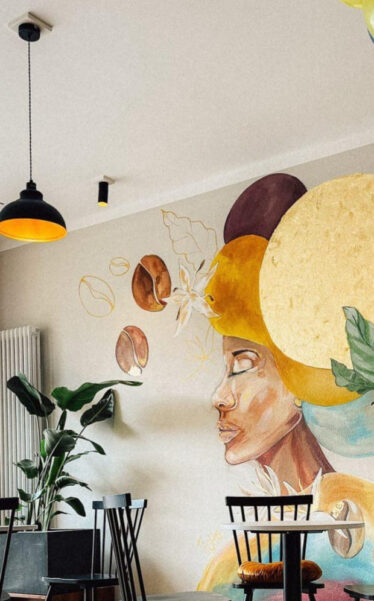
Her words place migration in a different space.
Not as a definitive rupture. But as a shaping process. Liliana Martínez does not deny difficulty. Yet she does not dwell in it. She speaks from a place where movement becomes awareness and displacement becomes a clearer way of seeing oneself.
Laura Viera A: Is it complicated?
Liliana Martinez: It is complex, but not impossible. It depends a lot on attitude. But also on recognizing where you feel most complete. Returning is valid. Being a migrant for a limited time is also valid.
In that statement, there is an uncommon sense of freedom. Migration is neither condemnation nor romantic ideal. It is an open and changing experience. It can stop, transform, and it can even reverse. And none of that implies failure. Staying—or returning—can also be a conscious choice.
At this point, I return to a broader question. One that almost always emerges when creating far from the origin is discussed.
Laura Viera A: What personal lessons has this process left you?
Liliana Martinez: Getting to know myself. Not being lukewarm or being afraid of who I am. Not confusing kindness with a lack of boundaries. Having a voice and speaking clearly. And understanding that when you look from compassion and empathy, what unites us is greater than what divides us.
These words do not impose themselves. They settle. And it is there that migration stops being only geographical displacement.
It becomes an inner school. The muralism of Liliana Martínez was also born from this journey. From observing from the outside. From looking with critical distance while maintaining a deep connection to her roots. Migration did not distance Liliana Martínez from her territory. It gave her new tools to understand it.
Laura Viera A: Do you ever feel your heart is divided?
Liliana Martinez: Yes and no. Identity is something you carry with you. In the end, even in our home countries, we create small worlds where we feel safe. As migrants, we do the same. No one relates to an entire country. We all live within a small daily circle.
My art largely originates in my country—its colors, its fauna, its flora, and its people. It is a way of giving back everything I take from it, and of bringing that essence to Europe in order to establish a connection between both places. Ultimately, it allows us to realize that we are not so different when it comes to our shared human essence. – Liliana Martinez –
This idea dismantles one of the most repeated narratives about migration: total uprooting. Instead, Liliana Martínez proposes something more real and livable. The creation of micro-territories. Affective communities. Circles where belonging is built day by day.
I then ask about the relationship between movement and creation. I ask about the widespread belief that artists need to go far away in order to breathe.
Laura Viera A: Do you think traveling is necessary to “breathe” and create art?
Liliana Martinez: Traveling nourishes you. But being at home and investing in your own space also stimulates you. I don’t need great distances or exotic places to feel inspired. A sunrise from my window inspires me too. So does my family.
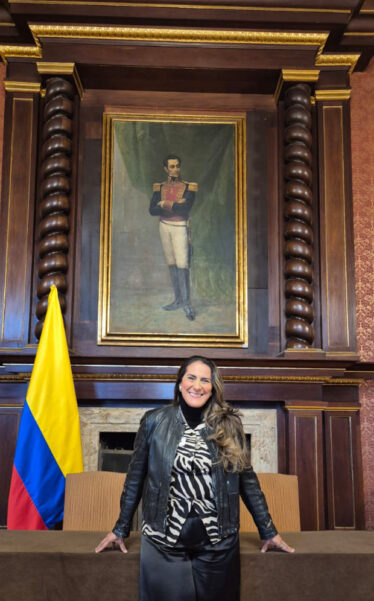
Here, migration stops being displacement and instead becomes gaze. In this sense, movement is not always geographical. At times, it is internal. At other moments, it happens without leaving home. Thus, everything learned outside—clarity, boundaries, compassion, listening—gradually transforms into line, color, and presence.
In the case of Liliana Martínez, migration is not a wound on display. Rather, it becomes another layer of her visual language. From this in-between space, the muralism of Liliana Martínez is built, where identity does not dissolve; on the contrary, it expands.
As a result, her work stops speaking only about herself. Instead, it begins a dialogue with public space, territory, and those who inhabit it. In this way, her practice understands the mural as an encounter, as shared memory, and as the possibility of connection.
From Movement to Lived Presence
Movement often marks the beginning of a journey, but it does not define its entirety. After years shaped by displacement, adaptation, and learning across territories, a different question inevitably emerges—one that shifts the focus from motion to grounding. In the work of Liliana Martínez, this moment signals a transition: a passage from constant movement toward a presence that is lived, intentional, and deeply rooted in experience.
After displacement, constant learning, and the daily negotiation that comes with living between territories, a moment arrives. Gradually, the question is no longer where to move; instead, it becomes where to create from. In the work of Liliana Martínez, this shift appears as a need to remain and to deepen—to look inward while still sustaining dialogue with the outside.
As a result, the muralism of Liliana Martínez enters a more introspective phase. Identity is no longer approached solely as origin or as a migratory condition. It becomes something alive—shaped by experience, by time, and by the accumulation of encounters across cultures. This shift is subtle but decisive.
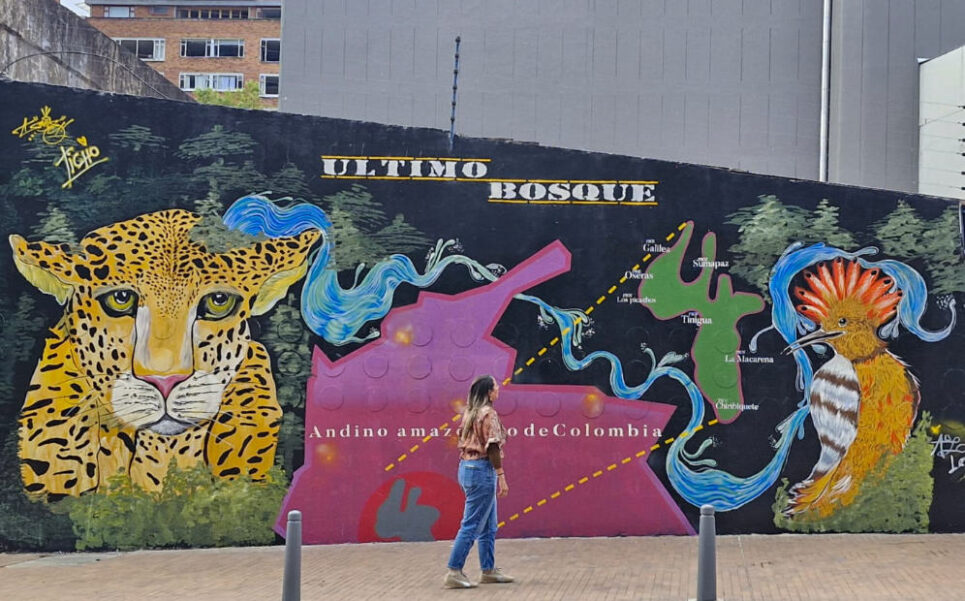
It is not a matter of abandoning the themes that have long been present in her work. Rather, it is about inhabiting them from a different place.
After years of movement, there comes a moment when the search naturally turns inward. For Liliana Martínez, this does not mean stopping. It means choosing to remain—with intention.
Her central axes persist—biodiversity, memory, community—but they now pass through a more personal filter. There is less urgency to explain and a greater openness to feel. In this space, identity is no longer only an origin point. It becomes experience lived, embodied, and continually unfolding.
Laura Viera A: Where do you feel your work is heading now?
Liliana Martínez: By 2026, I want to deepen my identity—not only as a Colombian woman, but as Liliana, with my own story, in a more particular way.
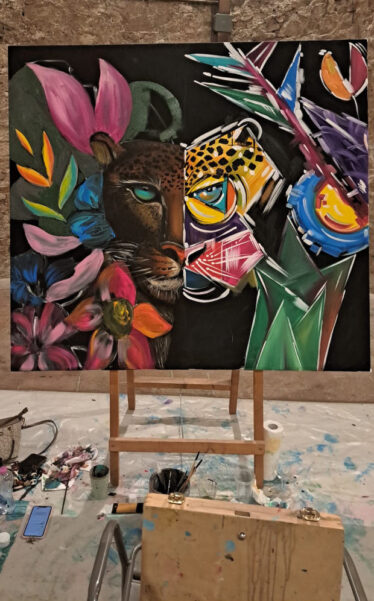
This impulse to narrate herself from a more personal place does not arrive as a rupture. It comes instead as a distillation—a quiet concentration of what has been lived, observed, and carried over time.
Liliana Martínez is no longer only the artist who arrives, observes, and enters into dialogue with a territory. She allows herself to inhabit it fully.
In this phase of her work, a recurring image surfaces in both her language and her practice: bare feet—contact without mediation, presence without armor.
This shift does not mark an endpoint, but a deepening. What once unfolded through movement and crossings now takes form through presence, attention, and embodied experience.
From here, her work no longer searches for direction. It begins to speak from within, opening the way toward a practice rooted in intimacy, awareness, and continuity.
Creating with Bare Feet
At a moment when movement slows and attention deepens, creation begins to demand a different kind of presence. For Liliana Martínez, this shift is expressed not through grand gestures, but through a conscious return to the body and to the ground beneath it.
Laura Viera A: You often talk about creating with bare feet. What does that mean to you?
Liliana Martínez: For me, it is a form of connection—with the earth, with the place where I am, and with the present. Painting with bare feet means truly being there, without so much protection and without so many layers. It means feeling the space before intervening.
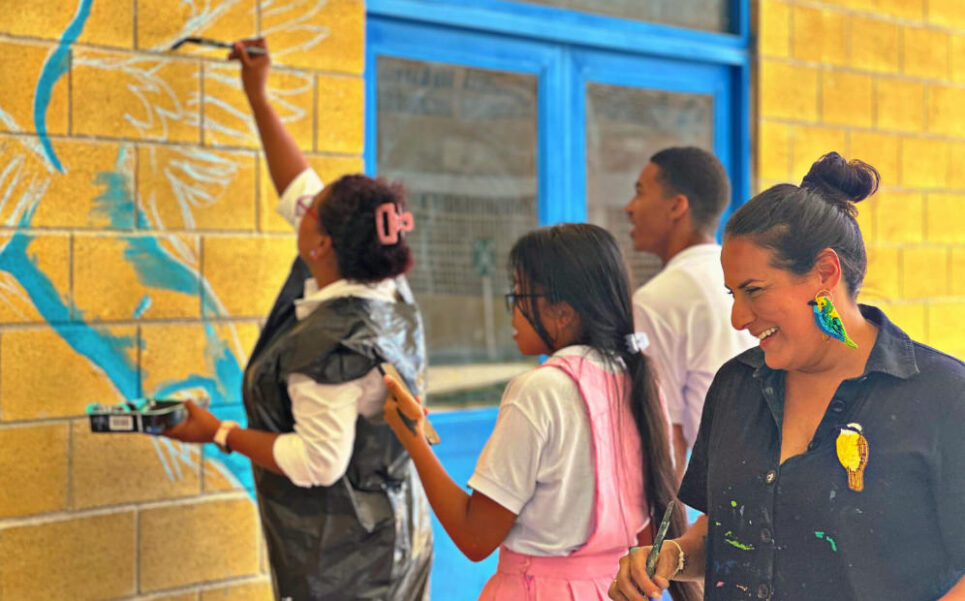
This idea is not merely metaphorical. Rather, it speaks directly to how Liliana Martínez positions herself before the wall and the territory—through listening, humility, and real presence.
Creating with bare feet involves accepting vulnerability; at the same time, it demands commitment. It is not about imposing an image, but about allowing the environment to enter into dialogue with the process.
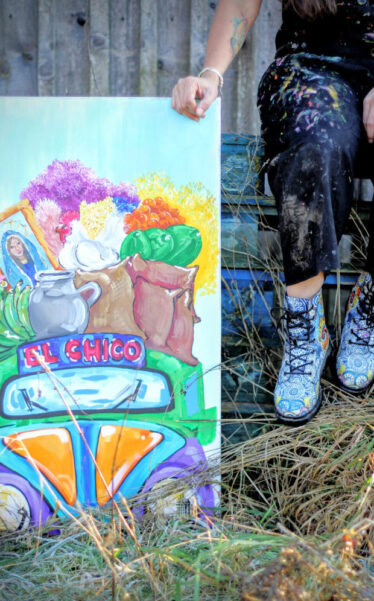
This sensitivity is already evident in recent projects that have deeply marked her practice: murals created in Colombia that weave together memory, literature, and territory, as well as interventions designed to protect ecosystems and make local struggles visible.
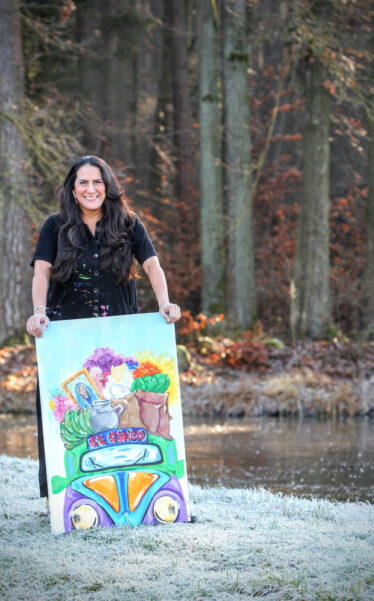
In each case, her muralism is a connective thread.
It stitches together dispersed stories and links the intimate with the collective without imposing a single reading. There is a clear maturity in this approach, one that allows the wall itself to hold complexity.
In this way, creating with bare feet is not only a method, but an ethic. It reflects a way of working that privileges listening over imposition and relationship over control.
Through this grounded presence, Liliana Martínez allows her muralism to remain open—capable of holding multiple stories, tensions, and meanings at once.
The wall is no longer a surface to conquer, but a space to inhabit, one that carries memory, vulnerability, and the possibility of shared understanding.
Depth, Vulnerability, and Territory
At a certain point in an artistic journey, technique and experience are no longer the central questions. What comes into focus instead is positioning: how one stands before the world, before the wall, and before others.
For Liliana Martínez, this moment is marked by a growing willingness to work from vulnerability—not as exposure, but as presence. From this place, depth becomes a form of listening, and territory is no longer only geographical, but relational. It is here that her practice opens new paths for dialogue, identity, and encounter.
Laura Viera A: Would you say you now work from a more vulnerable place?
Liliana Martínez: Yes, and I believe that is a strength. Being barefoot also means accepting that you do not always have control. The process leads you, and that is where more honest things happen.
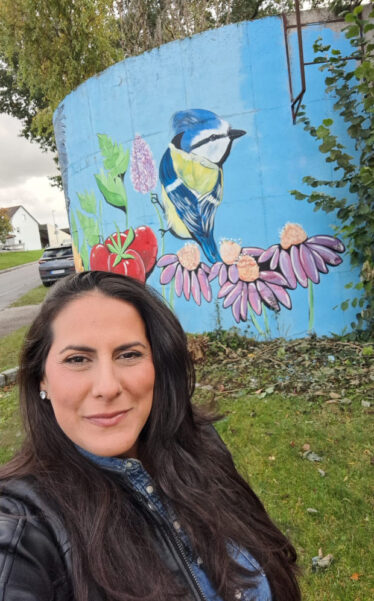
Rather than leading to isolation, this personal depth expands the field of dialogue and opens new possibilities for exchange. Thus, the question arises of how her Colombian identity manifests in her work in Germany.
Her response does not arrive as an explanation, but as something already lived. It is embedded in her creative gesture itself—in color, in the way space is inhabited, and in how she relates to everyone involved in the process.
Laura Viera A: Do you feel your work is a bridge between cultures?
Liliana Martínez: I work all the time for that to be the case. Germany has changed a lot. There is resistance, but there are also new forms of communication. My art can help lower defenses. In the end, I stopped being “the migrant.” I became an artist.
Within this transition, something emerges that is both deeply political and profoundly human. On the one hand, the muralism of Liliana Martínez does not seek to erase differences; on the other, it refuses to remain confined by them. Instead, it proposes a shared space—one in which encounter becomes possible, where the wall no longer functions as a border and begins to exist as a common surface.
Rather than limiting her work, this personal depth actively expands it. From this point forward, the mural becomes a bridge—capable of holding differences without denying them. In doing so, it opens spaces where conversation is not only possible, but necessary.
Whether in Germany, in Colombia, or in any in-between territory, the muralism of Liliana Martínez no longer speaks from the category of migration. Instead, it speaks from presence: from an artist who creates with her feet on the ground, her body attentive, and a deliberate will to connect.
In this way, every wall becomes a shared place of passage. Ultimately, this approach prepares the ground for an artistic practice that continues to move forward, fully aware of its power to connect and transform.
What Remains
Thinking about the future does not pull Liliana Martínez away from the present. She speaks of what is coming as an extension of what is already alive: cultural exchanges, school projects, traveling exhibitions, and the recognition that will return from Colombia.
None of it appears as an arrival or a victory, but rather as part of a conversation that is still unfolding. There is excitement in her voice, yes, but also a soft, almost disarming laughter that reveals an awareness of uncertainty: the knowledge that creation offers no guarantees, and that continuing to make art is, in itself, a quiet act of trust.
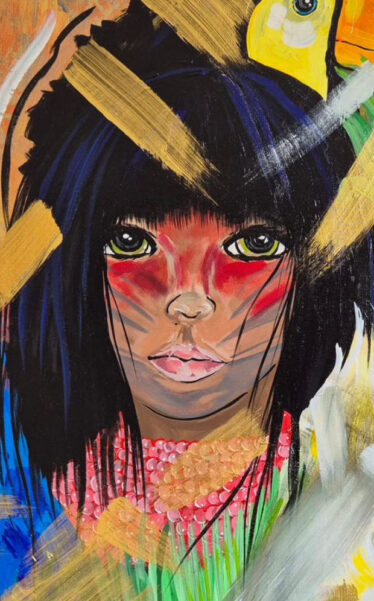
When she looks back, Liliana acknowledges that one of her greatest dreams has already come true: making a living professionally from art, not as a moment of arrival, but as a sustained way of being in the world. Still, she refuses to place a final period there.
What moves her remains unchanged. The desire to impact communities without instrumentalizing them. To open worlds rather than explain them. To keep learning, even when learning means unlearning what once felt certain.
As I close this conversation, something becomes clear to me. Writing about Liliana Martínez is not about describing a trajectory or organizing a body of work. It is about accompanying a process that is still unfolding.
Her muralism cannot be measured only in painted walls or completed projects. It lives in the relationships she builds, in the questions she leaves deliberately open, in the way each mural becomes a shared space rather than a finished statement.
Perhaps that is where her work finds its true dimension. When art is born from closeness—toward people, toward place, toward lived experience—it does not end where it begins. It continues in those who pass by, in those who participate, and in those who recognize themselves, unexpectedly, reflected in a wall that once was empty.